Key facts
- The Plaza de Armas, the illuminated Qorikancha and the viewpoints are free and can be reached on foot from the center.
- The dances at the Centro Qosqo de Arte Nativo are included in the full Tourist Ticket and the Circuit II partial ticket.
- San Blas has the most relaxed cafés and bars; the nightclubs are on the streets leading off the Plaza de Armas.
- The dry season, from May to September, brings the clearest skies and the coldest nights, with an average low of −1 °C in June and July.
- Avoid alcohol for your first 48 hours at altitude and the night before a predawn excursion.
- Get around by radio taxi or ride-hailing app, and save the numbers for the Police (105), the Tourist Police and iPerú.
In this guide
- 1. The illuminated Plaza de Armas
- 2. The Qorikancha and Avenida El Sol at night
- 3. Dances at the Centro Qosqo de Arte Nativo
- 4. A peña or dinner show
- 5. The bars and cafés of San Blas
- 6. Stargazing under the Andean sky
- 7. The viewpoints: San Cristóbal and the Cristo Blanco
- The 7 plans at a glance
- Cusco at night by season
- Staying safe at night in Cusco
- What to wear for a night out
- Nights out and your predawn excursions
- Cusco at night with kids
- Summary: what to do for your situation
Cusco at night comes down to 7 plans: the illuminated Plaza de Armas, the Inca walls of the Qorikancha, the dances at the Centro Qosqo de Arte Nativo, a peña with Andean music, the bars and cafés of San Blas, stargazing and the viewpoints over the city lights. Almost everything is in the historic center and can be done on foot. Bring a warm layer: once the sun goes down, the temperature drops fast.
Night falls early in Cusco. Because the city is in the tropics, the sun sets between 5:30 p.m., from May to July, and 6:20 p.m., in January and February: the time barely changes over the year. From then on, the churches and Inca walls light up. Here are the plans, how much time they take, what they cost and how to fit them around your predawn excursions.
Important: Cusco sits at about 3,399 m. The U.S. CDC advises avoiding alcohol for the first 48 hours at altitude and sticking to light exercise during those days. For your first few nights, choose low-key plans: the Plaza, the dances or a dinner with music. Save the bars and nightclubs for later. More information in our guide to altitude sickness in Cusco.
1. The illuminated Plaza de Armas
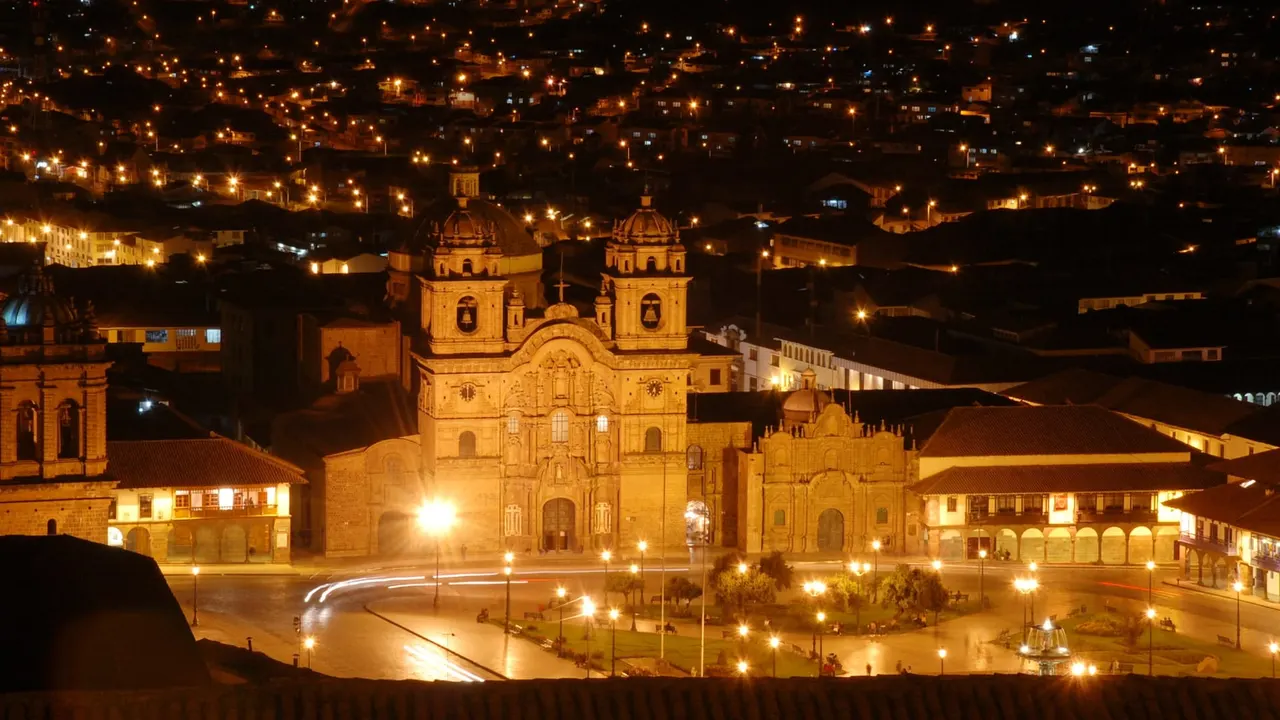
This is Cusco’s signature nighttime view. The Cathedral and the Church of La Compañía de Jesús are lit up in gold, the colonial arcades fill with people, and from the square you can see the lights of the upper neighborhoods on the hillsides. It’s the old Huacaypata, the great ceremonial square of the Inca capital, and it’s still the center of city life.
- Time needed: 30 minutes to an hour to stroll, sit by the central fountain and take photos.
- Price: free.
- Best time: right after sunset, when the sky is still dark blue and the facades are already lit. It’s the best light for photos.
- Practical tip: the second-floor balconies above the arcades have good views of the square; many of them are cafés or restaurants.
Plazoleta de las Nazarenas: a museum open until 10 p.m.
A few minutes’ walk from the Plaza de Armas is the Plazoleta de las Nazarenas, a small square that is quiet at night. One of its colonial mansions houses the Museo de Arte Precolombino (Pre-Columbian Art Museum), devoted to the art of ancient Peruvian cultures. According to its official website, it’s open every day, holidays included, from 8 a.m. to 10 p.m. It’s one of the few museum visits you can make after dinner.
- Time needed: about an hour.
- Admission: it has its own ticket; it isn’t part of the Tourist Ticket.
- Who it’s for: rainy nights and your first days in the city, when it’s best to avoid alcohol and strenuous activity.
2. The Qorikancha and Avenida El Sol at night
The Qorikancha was the most important temple of the Inca Empire. At night the complex is closed, but its curved wall of polished stone, lit up, can be seen from Avenida El Sol and the outer gardens. It’s one of the best examples of Inca stonework in the city, and at night you can really appreciate how the stones fit together. More history in our guide to the Qorikancha.
- Time needed: 15 to 20 minutes.
- Getting there: a five-minute walk from the Plaza de Armas, down Avenida El Sol or along Calle Loreto, which is lined with another Inca wall.
- Price: free from the outside. If you want to see the inside, go during the day: the temple has its own admission fee.
- Practical tip: combine it with the dances at the Centro Qosqo de Arte Nativo, which is on the same avenue.
A walk past the illuminated Inca walls
If you want to combine the Qorikancha with other Inca walls, this walk starts at the Plaza de Armas and takes an unhurried hour, almost all of it on level ground:
- Calle Loreto: it leaves the Plaza next to the Church of La Compañía de Jesús. It’s a pedestrian lane between two long Inca walls.
- Qorikancha: one block past the end of Loreto, the illuminated curved wall, seen from Avenida El Sol and the gardens.
- Back to the Plaza: walk up Avenida El Sol.
- Calle Hatun Rumiyoc: leave the Plaza by Calle Triunfo, next to the Cathedral. In two or three minutes you reach the wall of the former residence of the Inca Roca, with the Twelve-Angled Stone.
- San Blas, if you still have the energy: the hill starts at the end of Hatun Rumiyoc and takes you to the neighborhood’s little plaza, a good place for dinner.
Look and take photos, but don’t touch or lean on the walls: they’re protected heritage, and some blocks, like the Twelve-Angled Stone, have already been damaged.
3. Dances at the Centro Qosqo de Arte Nativo
The Centro Qosqo de Arte Nativo is one of Cusco’s most representative cultural institutions, devoted to preserving the music and dances of the region’s provinces. Every night, in its hall on Avenida El Sol, it puts on a show with live musicians and dancers in traditional costumes. It’s the easiest way to grasp the diversity of festivals and communities in the southern Andes.
- Schedule: a daily show at nightfall, lasting about an hour. Confirm the time at the box office or with your hotel, because it can change.
- Admission: included in the Cusco Tourist Ticket, both the full ticket, valid for 10 days, and the Circuit II partial ticket, which covers the city and the South Valley.
- Who it’s for: everyone, including kids and travelers who’ve just arrived. You’re seated and indoors.
- Practical tip: arrive early; the best seats fill up fast in peak season.
How to confirm the show time
The Centro Qosqo de Arte Nativo currently has no reliable schedule published online: the domain it used as its website no longer leads to its page. Ask for the time at the box office on Avenida El Sol, or call Cosituc, which runs the Tourist Ticket, at 084 261465. Keep in mind that the Tourist Ticket isn’t sold at the theater: buy it beforehand at the Cosituc counter or at one of the archaeological sites in the program.
Tip: if you spend the afternoon on a city tour of the temples and nearby ruins, you’ll already have the Tourist Ticket in hand. When you get back, have a light dinner and go to the dances that same night: you make the most of the ticket without using up a day.
4. A peña or dinner show
Peñas are venues where you have dinner or a drink while a band plays live Andean music: quena, zampoña (panpipes), charango and bombo drum. Many include traditional dances between courses. Cusco has two kinds: the dinner shows at downtown restaurants, designed for travelers and with an international menu, and the more local peñas, where the audience gets up to dance at the end.
- Time needed: two to three hours, with dinner.
- Price: many venues add a cover charge for the show or include it in a set menu. Ask before you sit down.
- Where: on the streets around the Plaza de Armas and in San Blas.
- Practical tip: it’s a good time to try traditional dishes. What to order is in our guide to traditional Cusco food.
5. The bars and cafés of San Blas
San Blas is the artisans’ neighborhood and, at night, the most bohemian part of Cusco: cafés with live music, small bars in colonial mansions, workshops that stay open late and a little plaza with a view over the rooftops. The atmosphere is relaxed and good for conversation, very different from the nightclubs. Read our guide to the San Blas neighborhood.
- Time needed: as long as you like: a coffee and dessert or the whole night.
- Getting there: a five-minute walk from the Plaza, up Calle Triunfo and Hatun Rumiyoc. The hills and stairways are steep: take them slowly.
- Other areas: if you’re looking to party and dance, the nightclubs and loud-music bars are concentrated on the streets leading off the Plaza de Armas, such as Procuradores and Plateros, and in the second-floor venues around the square.
- Practical tip: on the Plaza, people will hand you cards for free drinks to get you into the nightclubs. If you take one, keep an eye on your glass.
6. Stargazing under the Andean sky
From Cusco you can see the Southern Hemisphere sky, with the Southern Cross and the center of the Milky Way high overhead. The Incas didn’t just look at the stars: they also read the dark patches of the Milky Way, which they called Mayu, “river.” In it they saw animal figures, such as the llama, which helped them organize the farming calendar.
- Where: there’s a lot of light inside the city. For a truly dark sky, you need to head to the outskirts, toward the Sacsayhuamán area, where there are planetariums and observatories that pair a talk on Inca astronomy with telescopes. Book them in advance; they usually include transportation.
- Best season: the dry season, from May to September, with clear skies almost every night. From December to March, clouds often cover the sky.
- Practical tip: pick a night close to the new moon and bring seriously warm clothes: out in the open in June and July, the temperature can drop below 0 °C.
If you’ll be spending the night in the countryside, as on the Inca Trail or in the Sacred Valley, you’ll get even better skies for free.
7. The viewpoints: San Cristóbal and the Cristo Blanco
The best view of Cusco lit up is from above. From up there, the city looks like a blanket of lights in the valley, with the Plaza de Armas glowing in the middle.
San Cristóbal viewpoint
This is the esplanade in front of the Church of San Cristóbal, above the Plaza de Armas, halfway up to Sacsayhuamán. You can walk up in about 15 minutes along steep streets, or take a taxi. It’s the closest and busiest viewpoint.
Cristo Blanco
The white statue of Christ, next to Sacsayhuamán, overlooks the whole city. During the day you can walk up, but at night we recommend taking a taxi there and back: the path goes through unlit areas.
- Price: both viewpoints are free.
- Best time: at sunset, to watch the lights come on.
- Practical tip: don’t go up alone late at night. Go in a group and ask the taxi driver to wait for you.
Monument to Pachacútec
The great statue of the Inca Pachacútec, at the roundabout of the same name at the end of Avenida El Sol, stands on a tower with a viewing deck over the city and rooms about Inca culture. It’s included in Circuit II of the Tourist Ticket, the same one as the dances. Cosituc doesn’t publish its opening hours online: confirm them at its counter before planning a sunset there.
The 7 plans at a glance
| Plan | Time | Price | Effort | Ideal for |
|---|---|---|---|---|
| Illuminated Plaza de Armas | 30 min to 1 h | Free | Low | Your first night |
| Qorikancha at night | 15 to 20 min | Free from the outside | Low | Photos of Inca walls |
| Centro Qosqo de Arte Nativo | 1 h | With the Tourist Ticket | Low | Families and new arrivals |
| Peña or dinner show | 2 to 3 h | Dinner plus cover charge or set menu | Low | Couples and groups |
| San Blas bars and cafés | Up to you | Depends on what you order | Medium, because of the hills | A bohemian vibe |
| Stargazing | 2 to 3 h | Planetarium with a reservation, or free in the countryside | Low | The dry season |
| Viewpoints | 1 h | Free (taxi extra) | Medium on foot | Seeing the city lit up |
Cusco at night by season
The season changes the night more than the day. The high hovers around 20 to 22 °C all year, but the lows vary a lot. All the data, month by month, is in our guide to Cusco weather.
- Dry season, May to September: clear, very cold nights, with an average low of −1 °C in June and July on the outskirts, according to SENAMHI. It’s the best time for stars and viewpoints, and the liveliest time on the streets.
- Rainy season, December to March: milder nights, but with frequent showers in the afternoon and evening. Keep an indoor plan handy: the dances, a peña or dinner.
- June: it’s Cusco’s jubilee month, with parades and festivities almost every day, Corpus Christi and Inti Raymi every June 24. The city fills up and the nights run late.
- December: on December 24, the Plaza de Armas hosts Santurantikuy, the big Christmas handicrafts fair.
What time it gets dark and how cold it gets, month by month
The table combines the approximate sunset time in the middle of each month, calculated with the NOAA solar calculator, and SENAMHI’s average low, from the 1991–2020 climate normals for the Granja Kcayra station, at 3,214 m on the outskirts of the city. Because Cusco is ringed by hills, the sun disappears behind them a little before that time.
| Month | Sunset (approx.) | Average low | What the night is like |
|---|---|---|---|
| January | 6:20 p.m. | 7 °C | Mild, with frequent rain |
| February | 6:20 p.m. | 8 °C | Mild, with frequent rain |
| March | 6:00 p.m. | 7 °C | Mild; the rains start to ease |
| April | 5:40 p.m. | 4 °C | Cool and almost dry |
| May | 5:30 p.m. | 1 °C | Cold and clear |
| June | 5:30 p.m. | −1 °C | Freezing and clear |
| July | 5:35 p.m. | −1 °C | The coldest of the year |
| August | 5:40 p.m. | 1 °C | Freezing and clear |
| September | 5:45 p.m. | 3 °C | Cold; starting to get milder |
| October | 5:45 p.m. | 5 °C | Cool; first afternoon rains |
| November | 5:55 p.m. | 6 °C | Cool; afternoon rains |
| December | 6:10 p.m. | 7 °C | Mild, with frequent rain |
“Mild” is relative: even in January the night hovers around 7 °C on the outskirts, so never go out without a warm layer.
More festive nights on the calendar
- Holy Monday: the procession of the Lord of the Earthquakes, Cusco’s patron, leaves the Cathedral in the afternoon, winds through the center and returns after dark, amid a huge crowd.
- May 2: the Cruz Velacuy begins with a serenade to the crosses of neighborhoods and churches, decorated with flowers and altars with colored candles.
- December 31: the Plaza de Armas welcomes the New Year with thousands of people. For New Year 2026, the city government scheduled events from 6 p.m., with the Andean Saminchay ritual in front of the Cathedral, music on a stage and fireworks just before midnight, and expected more than 50,000 people. Many wear yellow.
Dates and rules for each celebration are in our calendar of Cusco festivals.
Staying safe at night in Cusco
Cusco’s historic center is lively and busy until late, and most travelers have no problems. Even so, it’s worth following the precautions you’d take in any tourist city:
- Get around by radio taxi or ride-hailing app. Ask your hotel or restaurant to call one for you, and avoid taxis that pick people up off the street in the early morning hours.
- Watch your drink. Don’t leave it unattended and don’t accept drinks from strangers.
- Carry only what you need. Cash for the night, a copy of your passport and your phone tucked away safely.
- Avoid deserted streets and stairways in San Blas, San Cristóbal and the upper neighborhoods late at night. Head back with company.
- Save the useful numbers. Police: 105. iPerú, PromPerú’s free tourist information and assistance service, is available 24 hours a day at (01) 574-8000 and on WhatsApp at 944 492 314, and has offices on Avenida El Sol and at the airport.
Important: a severe headache that won’t go away, confusion, difficulty walking or shortness of breath at rest are not a hangover: they can be signs of serious altitude sickness. Seek medical care immediately. If you have heart or respiratory problems, are pregnant or are traveling with children, check with your doctor before the trip.
The Tourist Police
Peru’s National Police has a unit in Cusco that specializes in travelers, the Tourist Police. In January 2023, Mincetur, Peru’s tourism ministry, published these numbers: Cusco Tourist Police, 084 235123 and 989 235154, and the Tourist Police central line, 980 122 335. If you’re robbed at night, report it as soon as possible: travel insurers usually ask for a police report. More numbers and advice in our guide Is Cusco safe?
Bars, nightclubs and city rules
City rules affect your safety too. The regulations of the Master Plan for Cusco’s Historic Center don’t allow nightclubs, bars or karaoke venues inside the historic center, and the Provincial Municipality of Cusco is the only authority that sets each venue’s opening hours. Even so, many operate on the streets near the Plaza. The city’s schedule of penalties provides for closing venues that open without a license, stay open past their authorized hours or lack the building safety inspection certificate (ITSE), and for fines on venues that sell alcohol to drink in the street.
- Choose venues with a visible exit and no crowds packed onto stairs or in hallways. Many are on the second floor of old mansions.
- There’s no single published closing time for the whole city: it depends on each venue’s license, and on special dates the authorities can bring closing time forward.
- Dry law: on election days, Peru’s Organic Elections Law bans alcohol sales from 8 a.m. the day before the vote until 8 a.m. the day after, and venues devoted to selling it close.
What to wear for a night out
Dress in layers, as you would for a day in the mountains: a thermal base layer, a fleece and a windproof jacket. Add a hat and gloves from May to August, and a light rain jacket from December to March. Venues are often poorly heated. Wear comfortable shoes with good soles: the stone streets get slippery when it rains. The full list is in our Cusco packing list.
Nights out and your predawn excursions
Many excursions from Cusco leave before sunrise. Keep these times in mind before you stay out late:
- Rainbow Mountain day trip: pickup usually between 4:00 and 4:30 a.m., and a hike up to about 5,036 m.
- Humantay Lake day trip: pickup usually around 4:30 a.m.
- Machu Picchu in one day: you leave between 4:00 and 5:00 a.m. and get back to Cusco at night.
The night before those trips, have an early dinner with no alcohol and lay out your warm clothes. Nighttime plans fit best after a city tour, after your arrival day if you feel well, or after a day in the city. Plan your days with the 3-, 5- and 7-day Cusco itineraries.
Cusco at night with kids
With kids, the best plans are the illuminated Plaza de Armas, the dances at the Centro Qosqo de Arte Nativo and an early dinner with live music. They love the stars too, if the planetarium has a family-friendly talk. Avoid the viewpoints late at night and bundle them up well: the nighttime cold affects them more.
Summary: what to do for your situation
- It’s your first night: a stroll around the Plaza de Armas and a light dinner. No alcohol.
- You have the Tourist Ticket: the dances at the Centro Qosqo de Arte Nativo and the illuminated Qorikancha, on the same avenue.
- You’re traveling as a couple: sunset at a viewpoint and a dinner show with Andean music.
- You want to party: San Blas bars and nightclubs near the Plaza, with a taxi back.
- You’re passionate about the night sky: a planetarium on the outskirts, in the dry season and at new moon.
- It’s raining or you’d rather not drink: the Museo de Arte Precolombino, open until 10 p.m., or the dances at the Centro Qosqo.
- You don’t want to spend money: the Plaza de Armas, the walk past the illuminated Inca walls and the San Cristóbal viewpoint.
- You’re spending New Year’s Eve in Cusco: the Plaza de Armas, with a warm layer, little cash and your phone tucked away safely.
- You’re leaving before dawn tomorrow: save the night out for another day.
For the rest of the day, see things to do in Cusco: 12 must-see places.
Frequently asked questions
Is Cusco safe at night?
The historic center stays busy until late and is a calm area for a stroll. Take the usual precautions: use a radio taxi, don’t leave your drink unattended and avoid deserted streets in the early morning hours.
What time is the show at the Centro Qosqo de Arte Nativo?
There’s a show every night at nightfall, lasting about an hour. Since the schedule can change and there’s no reliable one published online, confirm it at the box office on Avenida El Sol or with Cosituc at 084 261465.
How cold does Cusco get at night?
It depends on the time of year: in June and July the average low is −1 °C on the outskirts, according to SENAMHI, and from December to March the nights are milder, 7 to 8 °C, but rainy.
What time does it get dark in Cusco?
The sun sets between 5:30 p.m., from May to July, and 6:20 p.m., in January and February, according to the NOAA solar calculator. Because the city is ringed by hills, direct sunlight fades a little earlier.
Where are the bars and nightclubs in Cusco?
The relaxed bars with live music are in San Blas. The nightclubs are concentrated around the Plaza de Armas and on nearby streets such as Procuradores and Plateros.
How late are bars and nightclubs open in Cusco?
There’s no single published closing time: the Provincial Municipality of Cusco sets each venue’s hours and can close any venue that goes past them. On special dates the authorities can bring closing time forward, and a dry law applies on election days.
Can you drink alcohol in Cusco with the altitude?
The CDC recommends avoiding it for your first 48 hours at altitude. After that, drink in moderation and have a glass of water with every drink.
Are any museums open at night in Cusco?
Yes. The Museo de Arte Precolombino, on the Plazoleta de las Nazarenas, is open every day from 8 a.m. to 10 p.m., according to its official website. The Centro Qosqo de Arte Nativo also puts on its dance show every night.
Where can you see the stars near Cusco?
Outside the city, at the planetariums and observatories on the outskirts or during a trek with a night in the countryside. The best time is the dry season, from May to September.
How is New Year’s Eve celebrated in Cusco?
In the Plaza de Armas, with thousands of people. For New Year 2026, the city government scheduled events from 6 p.m., with the Andean Saminchay ritual, music and fireworks just before midnight, and expected more than 50,000 people.
What is the phone number of the Tourist Police in Cusco?
According to Mincetur (January 2023), the Cusco Tourist Police can be reached at 084 235123 and 989 235154, and its central line at 980 122 335. For emergencies, the National Police number is 105.
What can you do in Cusco at night with kids?
Stroll around the illuminated Plaza de Armas, see the dances at the Centro Qosqo de Arte Nativo and have an early dinner with Andean music. Bundle them up well and head back by taxi.
Official sources
- Cosituc: Centro Qosqo de Arte Nativo cosituccusco.pe
- Cosituc: Tourist Ticket prices and validity cosituccusco.pe
CuscoSan Blas NeighborhoodQorikancha

How we put this guide together
Written by Paul Pumalloclla · 17 years in tourism
- Official sources Prices, opening hours and rules checked against Peru’s Ministry of Culture, SERNANP, PromPerú and the train and bus operators.
- Sources cited Every guide links to the sources we used at the end.
- Always up to date When a rule changes, we update the guide and its date.
We’re not a travel agency: we don’t sell tours or take bookings. If a link belongs to a commercial partner, we label it next to the link, and that never changes the facts or the recommendations.
Guide history
- Published
- Last reviewed
Spotted something out of date?
Let us know and we’ll check it against the official source.
Report a change