Key facts
- A Sacred Valley plateau town with Inca terraces, the remains of Túpac Inca Yupanqui’s palace and a colonial church.
- It’s in the province of Urubamba, 30 km from Cusco, about 35 minutes by car according to Mincetur’s tourism inventory.
- It sits at about 3,760 m, higher than Cusco: it’s better to visit on your way through than to sleep there to acclimatize.
- It’s famous for its naturally dyed textiles and its Sunday market, where bartering still takes place.
- The archaeological site is visited with the Cusco Tourist Ticket and opens from 7:00 a.m. to 5:00 p.m.; the town and the weaving centers are free to visit.
- Its patron saint’s feast, the Virgen de la Natividad, is on September 8, and an Inca road runs down from the town to Urquillos.
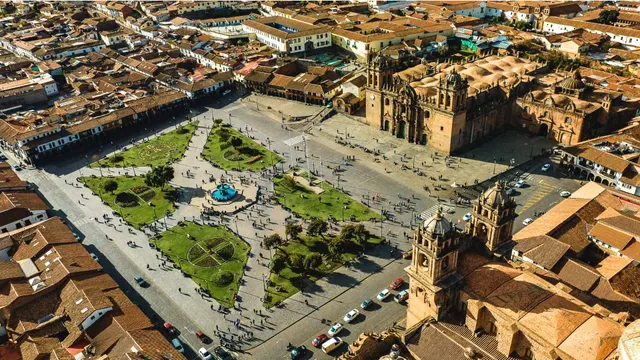
Chinchero is an Andean town on the high plateau of the Sacred Valley in Cusco, Peru, 30 km from the city of Cusco and at an elevation of about 3,760 m. It brings together an Inca archaeological site with terraces and the remains of Túpac Inca Yupanqui’s palace, a colonial church built on top of Inca walls and one of the most vibrant weaving traditions in the region, with a market on Sundays.
What is Chinchero?
Chinchero is at once a living town, an archaeological park and a colonial historic district. According to the Dirección Desconcentrada de Cultura de Cusco, the regional office of Peru’s Ministry of Culture, the area was already settled before the Incas, by the Killke culture, and later became a residence of the Inca Túpac Inca Yupanqui. After the conquest, the Spanish built the colonial town on top of the Inca structures. Today its residents keep weaving, bartering and traditional festivals alive.
The name has two explanations in Quechua, according to the entry in the tourism inventory of Mincetur, Peru’s Ministry of Foreign Trade and Tourism: one links it to chinchay, an Andean feline, and the other to sincheraq, “the powerful one,” a reference to Túpac Inca Yupanqui.
Chinchero or Chincheros: don’t mix them up
Search engines often show it as “Chincheros Peru,” but the Sacred Valley town is called Chinchero, singular. Chincheros, plural, is a different place, the capital of a province in the department of Apurímac, far from Cusco. If you’re looking for transportation or lodging, make sure it’s Chinchero, in the province of Urubamba.
A short history: from Inca retreat to colonial town
The chroniclers agree that Chinchero was the work of Túpac Inca Yupanqui. Juan de Betanzos (1551) writes that the Inca chose a plain with a large lake, two leagues from Cusco, and had a town of fine stonework built there for his own rest and that of the lords of Cusco; by his account, the work took five years. Pedro Sarmiento de Gamboa (1572) mentions his rich houses of leisure and the large estates the Inca had laid out for himself. Friar Martín de Murúa adds that Capac Huari, a son of the Inca who hoped to succeed him, was banished to Chinchero when Huayna Cápac took power, and that he lived there in isolation, never allowed to enter Cusco.
After the conquest, the town grew on top of the palace. The Spanish archaeologist José Alcina Franch, who excavated Chinchero in 1968 and 1969, dated the construction of the church to between 1570 and 1607; around that time the wall of niches was completed and the central staircase, the bell tower and the cross were built. Alcina also considered the great ceremonial space of the complex to be the square known today as Capellanpampa. For the wider context of the empire, read our guide to Inca history and culture.
Where is Chinchero and what is its elevation?
Chinchero is in the district of the same name, in the province of Urubamba, on the plateau that separates the city of Cusco from the floor of the Sacred Valley. You get there on the paved road from Cusco to Urubamba and Ollantaytambo: according to Mincetur’s tourism inventory, it’s 30 km and about 35 minutes by car to the town’s main square.
It sits at about 3,760 m, higher than Cusco (about 3,399 m) and almost a thousand meters above Ollantaytambo. Mincetur’s entry puts the archaeological park, on the slope next to the town, at 3,785 m. This is the most common mistake when planning the valley: Chinchero isn’t a good place to sleep during your first days if you want to acclimatize. Visit it on your way through and stay on the valley floor. More advice in our guide to altitude sickness in Cusco.
Chinchero and altitude sickness
The U.S. CDC considers unacclimatized travelers who will sleep at 2,450 m or higher, and sometimes lower, to be at risk of altitude illness. It advises against going from low altitude to a sleeping altitude above 2,750 m in a single day and, above 3,000 m, against raising your sleeping altitude by more than 500 m per night. It also notes that day trips with an evening return to a lower altitude are much less stressful.
For Chinchero, that boils down to two ideas. Don’t pick it for your first night if you’re arriving from the coast, and take advantage of the fact that it’s easier as a day trip, because in the evening you go back down to sleep in Cusco or the valley. The main symptom of acute mountain sickness is a headache, with loss of appetite, dizziness, fatigue or nausea, and it usually starts 2 to 12 hours after arrival. If you have symptoms, don’t go higher to sleep; if they get worse, go down: according to the CDC, descending 300 m or more usually helps. Urubamba, on the valley floor, is about 20 minutes away by road.
What to see in Chinchero
| Place | What it is | Key fact |
|---|---|---|
| Archaeological site | Inca terraces, enclosures, channels and huacas | About 43 hectares, with an urban sector and a farming sector |
| Church of the Nativity | Colonial church on top of the Inca palace | Colonial-era paintings, altarpieces and sculptures |
| Main square and Inca walls | Walls of the old palace next to the square | Inca stonework with visible niches |
| Site museum | Ministry of Culture museum on the main square | Pottery, metalwork, a puma sculpture and colonial paintings |
| Weaving centers | Workshops run by the town’s weavers | Demonstrations of washing wool and dyeing it naturally |
| Sunday market | Market for produce and crafts | Bartering between communities |
The Chinchero archaeological site
According to the Dirección Desconcentrada de Cultura, the archaeological park covers about 43 hectares and includes pre-Hispanic paths, enclosures, terraces, water channels, huacas and shrines. It’s divided into two large sectors: the urban one, with residential and ceremonial enclosures for the Inca nobility, around the present-day town, and the farming one, with the large terraces that run down the slope.
The historian Luis E. Valcárcel credits the Inca founding of Chinchero to Túpac Inca Yupanqui, son of Pachacútec, who is said to have ordered shrines, baths, terraces and his great palace built around 1480. The chronicles say the Inca died here under unclear circumstances. Walking down the terraces gives you one of the widest views of the plateau, with snowcapped mountains in the background on clear days.
Mincetur’s entry adds useful details for finding your way around. The park has a perimeter of about 2,638 m and spreads across the slope of Cerro Antaqasa. The urban sector includes the Capellanpampa square, the huaca of the Virgen Natividad and the colonial house of Mateo Pumacahua; the farming sector groups terraces with Quechua names such as Patapatayoq, Munaypata, Quillapata, Condorqaqa and Qentepata. According to the same entry, the complex was designed for rest, leisure and the worship of the sun, water and mountains, and the sun’s passage over certain points marked when to plant corn and potatoes.
A good example is the huaca of Sucanca. The chronicler Bernabé Cobo describes it as a hill where the Chinchero irrigation channel arrived, with two markers: when the sun reached them, it was time to start planting corn. Mincetur links it to an Inca canal that came from Lake Piuray.
The site museum
On the main square is the Museo de Sitio de Chinchero, founded in 1996 and run by the Ministry of Culture. Its two rooms display metal objects, ceremonial and everyday pottery, mortars and a puma-shaped sculpture found in local excavations. Its ethnographic collection shows farming tools, textiles and traditional clothing, and there are also colonial paintings from the 17th and 18th centuries. It’s a short stop that helps you make sense of what you then see on the terraces.
The colonial church
Above the main square stands the church of Nuestra Señora de la Natividad (Our Lady of the Nativity), which was first called Nuestra Señora de Monserrat. It dates from the early 17th century and was built on top of the walls of the Inca palace, which are still visible at its base and along the side of the square. Inside, it preserves murals on the ceilings and walls, altarpieces, altars and sculptures. The town’s historic district was declared part of Peru’s Historic Heritage in 1972.
The town’s patron saint is the Virgen de la Natividad, the image its residents are most devoted to, who leads the Corpus Christi procession in Chinchero every year. In 2025, the Dirección Desconcentrada de Cultura took the Virgin and seven other sculptures from the church, among them Saint James on horseback, Saint John the Baptist and Saint Michael, to its restoration workshops in Tipón because they had badly deteriorated.
The town is also home to the house of Mateo Pumacahua, the chief (cacique) of Chinchero who played a prominent role in Cusco’s history at the end of the colonial period.
Chinchero textiles
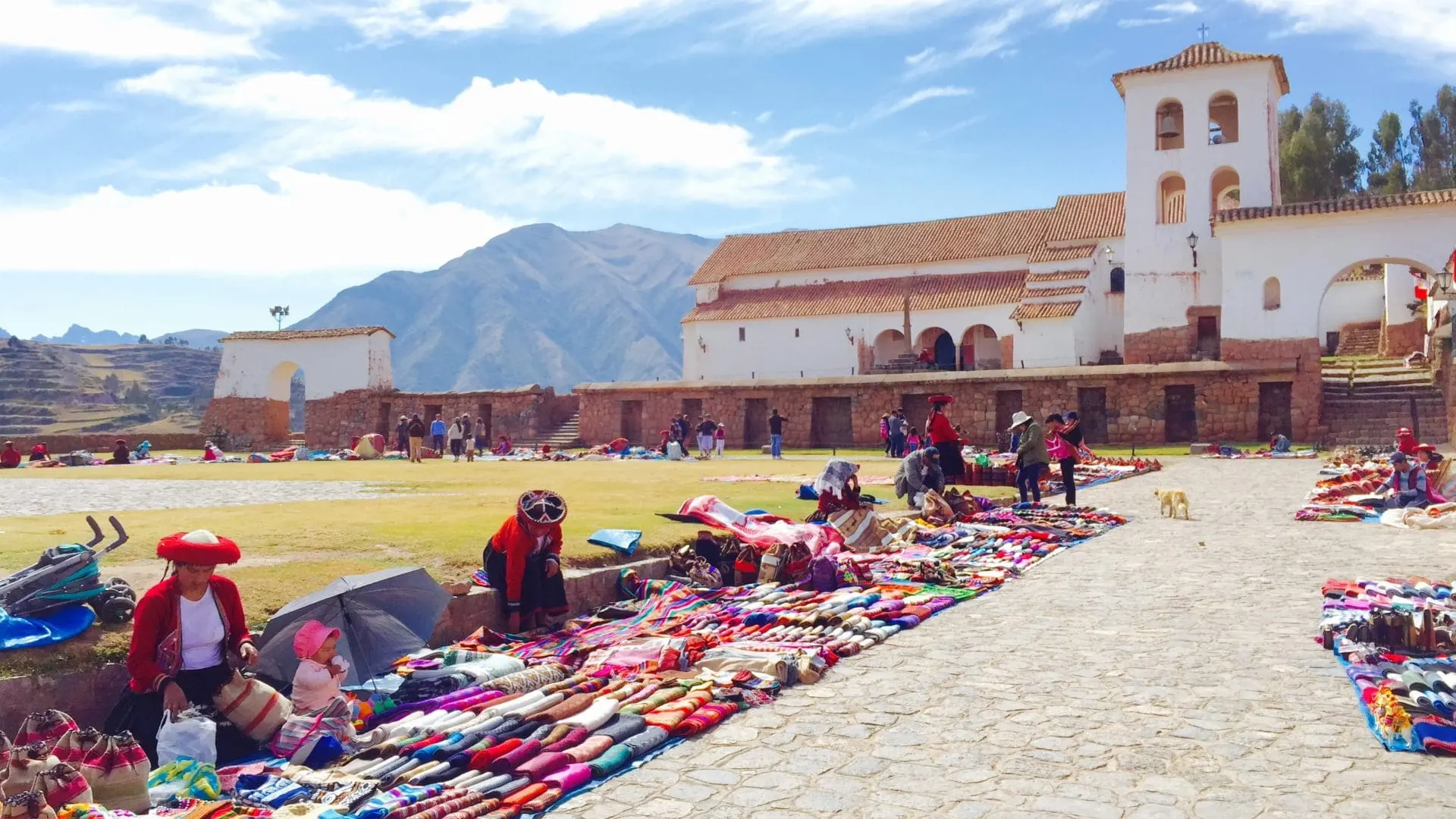
Chinchero is known for its textiles, which keep symbols from the Inca tradition and are colored with natural dyes. At the town’s weaving centers, the weavers usually show how they wash the wool with roots, how they get colors from plants, minerals and cochineal, and how they weave on a backstrap loom. The demonstrations are usually free: the centers make their living from selling their pieces.
Tip: if you want to buy a textile, ask who made it, how long it took and which dyes were used. A handmade piece with natural dyes costs more than a factory-made one, but the money goes straight to the weaving families.
The Sunday market
Sunday is the best day to go. Communities from the surrounding area come down to the town with their goods and, alongside the crafts, bartering is still practiced: trading potatoes, corn and other foods without money, which lets families vary their diet.
Festivals and customs
The Dirección Desconcentrada de Cultura highlights several practices the town keeps alive. In addition to weaving and bartering, the communities practice linderaje, a walk to recognize and maintain each community’s boundaries. Throughout the year there are festivals such as the Cruz Velacuy, in May, and Corpus Christi, with processions, dances and music. If your visit coincides with one of them, you’ll see the town at its liveliest. If you’re interested in the life of weaving communities beyond Chinchero, the Lares valley, north of the Sacred Valley, is another good option.
The biggest celebration is the patron saint’s feast, the Virgen de la Natividad, on September 8. Corpus Christi, on the other hand, moves every year: it falls on a Thursday, 60 days after Easter Sunday; in 2025 its main day in Chinchero was June 19. The region’s other celebrations, month by month, are in our guide to Cusco festivals.
Hiking from Chinchero to Urquillos on the Inca road
From Chinchero, a section of the Qhapaq Ñan, the Inca road network, runs down toward the Sacred Valley and ends in Urquillos, on the valley floor. The Andina news agency describes it as a moderate, downhill hike where you see the local plants, wildlife and apus (sacred mountains), and it’s also good for birdwatching. The Dirección Desconcentrada de Cultura has documented it as the Inca road from Chinchero to Urquillos.
There is no official figure for its distance or duration, and the trail has no entrance checkpoint or services along the way. It’s the way to link the plateau with the valley on foot.
Tip: since it’s almost all downhill, it’s harder on your knees than on your lungs. Bring water, a warm layer and trekking poles if you use them, start in the morning, and plan ahead how you’ll continue from Urquillos to Urubamba or back to Cusco by road.
Lake Piuray and the new airport
Near the town is Lake Piuray, one of the sources of drinking water for the city of Cusco. It’s a peaceful landscape of fields and communities, a good place for a walk if you have extra time. Its water already mattered in Inca times: Mincetur’s entry mentions the canal that linked it to the huaca of Sucanca.
The new Cusco international airport is also being built on the Chinchero plain. In January 2026, Peru’s Ministry of Transportation and Communications (MTC) reported that it was about 40% complete and estimated that it could begin operating in late 2027 or early 2028. In June 2026 the schedule shifted again: the MTC’s director general of civil aviation estimated that the physical works would be finished in the second half of 2028, with operational testing running into early 2029. By then the control tower contract had been signed, with work scheduled to start at the end of June, and the runway was still out to tender. Until it opens, flights keep arriving at the city’s airport: see how to get from Lima to Cusco.
How to get to Chinchero from Cusco
- Colectivo or minivan: the ones that run from Cusco to Urubamba via Chinchero stop in the town. They leave from stops downtown, such as Calle Pavitos; check with your hotel.
- Taxi: about 35 minutes; handy for combining it with Maras and Moray on the same day.
- Day trip: Chinchero is usually the last stop on Sacred Valley day trips, on the way back to Cusco, or the first one on Maras and Moray trips.
These are the distances and driving times given in Mincetur’s tourism inventory:
| Route | Distance | Time | How |
|---|---|---|---|
| Cusco → Chinchero main square | 30 km | 35 min | By car, paved road |
| Urubamba → Chinchero main square | 21 km | 20 min | By car, paved road |
| Main square → archaeological park | 200 m | 5 min | On foot |
Chinchero entrance fee and opening hours
The archaeological park and the church area are visited with the Cusco Tourist Ticket. According to Cosituc’s price list, the Sacred Valley partial ticket (circuit III) costs S/ 70 for foreigners, is valid for 2 days and also covers Pisac, Ollantaytambo and Moray; for Peruvians it costs S/ 40 and is valid for 1 day. The full ticket costs S/ 130 and S/ 70, and it’s valid for 10 days. The town, the market and the weaving centers are free to visit.
| Place | Hours | Entry |
|---|---|---|
| Archaeological park | Year-round, 7:00 a.m. to 5:00 p.m. | Full Cusco Tourist Ticket or circuit III partial ticket |
| Site museum | Every day, 8:00 a.m. to 5:00 p.m. | Separate fee: S/ 7 adults, S/ 4 college students, free for schoolchildren |
| Market | Sundays | Free |
| Town and weaving centers | No set hours | Free |
Fares checked on October 29, 2026. Confirm them on the official channel before you buy.
The park’s hours come from Mincetur’s inventory, and the museum’s from the Ministry of Culture’s museum portal.
Important: carry your ticket and your ID together. The ticket is issued in your name, and you’ll be asked for both at the entrance checkpoint to the complex, next to the church.
Chinchero weather
Because it’s on the plateau, Chinchero is colder and windier than the valley floor, and similar to or a bit colder than Cusco. From May to September the days are dry and sunny, but mornings and nights are freezing. From December to March it rains often and the countryside is green. Always bring a warm layer and sunscreen, even if you’re going at midday. Month-by-month data in our guide to Cusco weather.
When to visit Chinchero
- Best day: Sunday, for the market and the bartering.
- Best time of day: early. The park opens at 7:00 a.m., and Sacred Valley day trips usually come through at the end of the day, on the way back to Cusco.
- Best season: May to September, the dry season, for walking the terraces and hiking down to Urquillos. In the rainy season the landscape is greener, but the rain makes hiking harder.
- Special dates: the patron saint’s feast on September 8, Corpus Christi and the Cruz Velacuy, in May.
Tips for visiting Chinchero
- Go on a Sunday if you want to see the market with its bartering.
- Give it one to two hours: the church, the main square, the terraces and a weaving center, and a little more if you visit the museum.
- Walk slowly: at 3,760 m, the slopes tire you out more than you’d expect.
- Combine it: on the way to Urubamba and Ollantaytambo, or on the same outing as Maras and Moray.
- Respect the photo rules in the church: many colonial churches in Cusco don’t allow photos inside.
Summary: Chinchero for your trip
- You’re doing the Sacred Valley in one day: save it for the way back to Cusco, after Pisac and Ollantaytambo.
- You’re interested in textiles: visit a weaving center and, if you can, the Sunday market.
- You’re going to Maras and Moray: stop in Chinchero on the same outing.
- You like to hike: walk down the Inca road to Urquillos and finish the day in the valley.
- You’re looking for somewhere to sleep and acclimatize: the valley floor is a better choice than Chinchero.
The next step is to fit it into your trip: our 3-, 5- and 7-day Cusco itinerary combines Chinchero with the rest of the valley, and things to do in Cusco rounds up the other options in the region.
Frequently asked questions
Where is Chinchero?
In the province of Urubamba, in the Cusco region, on the plateau between the city of Cusco and the Sacred Valley, about 30 km from Cusco.
What is the elevation of Chinchero?
About 3,760 m above sea level, higher than the city of Cusco and almost a thousand meters above Ollantaytambo.
Are Chinchero and Chincheros the same place?
No. Chinchero is the Sacred Valley town, in Cusco. Chincheros is a different town, in the department of Apurímac.
What can you see at the Chinchero ruins?
The Inca terraces, the walls of Túpac Inca Yupanqui’s palace next to the main square and the colonial church built on top of them, with its murals.
What day is the Chinchero market?
Sunday. Nearby communities bring their goods, and bartering is still practiced alongside the sale of crafts.
How much is the entrance fee for Chinchero?
It’s visited with the Cusco Tourist Ticket. The Sacred Valley partial ticket costs S/ 70 for foreigners and the full ticket S/ 130, according to Cosituc.
How do you get to Chinchero from Cusco?
By colectivo bound for Urubamba via Chinchero, by taxi in about 35 minutes, or as part of a Sacred Valley or Maras and Moray day trip.
What are Chinchero’s opening hours?
According to Mincetur’s inventory, the archaeological park is open year-round from 7:00 a.m. to 5:00 p.m. The site museum opens every day from 8:00 a.m. to 5:00 p.m., and the town and the market have no set hours.
Is there a museum in Chinchero?
Yes. The Museo de Sitio de Chinchero, on the main square, has been run by the Ministry of Culture since 1996 and displays pottery, metalwork, a puma sculpture, textiles and colonial paintings. It has its own entrance fee.
When is the Chinchero festival?
The patron saint’s feast of the Virgen de la Natividad is on September 8. Corpus Christi, whose date changes every year, and the Cruz Velacuy, in May, are also important.
Can you hike from Chinchero to Urquillos?
Yes. A section of the Inca road runs down from Chinchero to Urquillos, on the floor of the Sacred Valley, on a moderate downhill hike. Plan your transportation from the valley ahead of time.
When will the Chinchero airport open?
There is no firm date. In June 2026, the MTC estimated that the physical works would be finished in the second half of 2028, with testing into early 2029. Until then, flights arrive at the airport in the city of Cusco.
Official sources
- Dirección Desconcentrada de Cultura Cusco: Chinchero Archaeological Park culturacusco.gob.pe · PDF · Download the original PDF
- Mincetur, Tourism Resources Inventory: Chinchero Archaeological Park (elevation, sectors, hours and access routes) consultasenlinea.mincetur.gob.pe
- Cosituc: Cusco Tourist Ticket price list cosituccusco.pe
- Cosituc: circuits and sites included cosituccusco.pe

How we put this guide together
Written by Paul Pumalloclla · 17 years in tourism
- Official sources Prices, opening hours and rules checked against Peru’s Ministry of Culture, SERNANP, PromPerú and the train and bus operators.
- Sources cited Every guide links to the sources we used at the end.
- Always up to date When a rule changes, we update the guide and its date.
We’re not a travel agency: we don’t sell tours or take bookings. If a link belongs to a commercial partner, we label it next to the link, and that never changes the facts or the recommendations.
Guide history
- Published
- Last reviewed
Spotted something out of date?
Let us know and we’ll check it against the official source.
Report a change