Key facts
- A colonial town and a major Inca archaeological park at the entrance to the Sacred Valley, in the province of Calca.
- According to Mincetur’s tourism inventory, it’s 32.4 km from Cusco, about 48 minutes from Calle Puputi; the park is 9.3 km farther up by road.
- The town is at 2,972 m; the park’s terraces climb from about 2,995 to 3,450 m.
- The ruins have 17 terrace sectors and seven groups of buildings, including the Intihuatana, Pisaqa, Qallaq'asa and Qantus Raqay, plus the Tankanamarka cemetery.
- The park is visited with the Cusco Tourist Ticket (circuit III or full ticket) and, according to Mincetur, is open from 7:00 a.m. to 6:00 p.m.; the town and its market are free to visit.
- On Sundays there’s a Sunday market on Plaza Constitución, and the varayoc, Cultural Heritage of the Nation, attend Mass.
Pisac (also spelled Písac or Pisaq) is a town and a major Inca archaeological park in the Sacred Valley in Cusco, Peru. According to the tourism inventory of Mincetur, Peru’s tourism ministry, it’s 32.4 km from the city of Cusco, about 48 minutes by road. The town sits at 2,972 m and is famous for its craft market; above it, on the mountain, spread terraces, temples and one of the largest Inca cemeteries in the region.
What is Pisac?
Pisac is two visits in one. Down below, next to the Urubamba River, is the colonial town, with its main square and its market. Up on the ridge of the mountain is the Pisac Archaeological Park, whose boundaries the Peruvian state set in 2002. According to Andina, the park covers some 9,063 hectares: it’s one of the most extensive Inca complexes in the Cusco area, with terraces, ceremonial sectors, dwellings, watchtowers, storehouses and tombs.
The name is linked to the pisaca, an Andean partridge that’s common in the area. In search engines it shows up in many forms, such as Pisac, Písac or Pisaq: they all refer to the same place.
Where is Pisac?
Pisac is in the province of Calca, at the entrance to the Sacred Valley when you’re coming from Cusco. The road leaves the city heading north, passes Sacsayhuamán and Tambomachay, crosses the high grasslands (the puna) and winds down to the valley, with a viewpoint over the river just before you arrive. That’s why it’s the first stop on almost every Sacred Valley day trip.
Its location is no accident. According to researcher Víctor Angles Vargas, quoted by RPP, Cusco, Pisac and Pikillacta form an almost equilateral triangle about 33 km on each side, and Pisac is thought to have guarded the approach to Cusco from the Antisuyo, the jungle region.
Pisac elevation
Pisac’s elevation depends on which part you measure. The town is at 2,972 m, about 400 m lower than Cusco. The archaeological park is much higher: according to RPP, its terraces were built between 2,995 and 3,450 m, and the main sector sits at around 3,300 m. In other words, when you climb up to the ruins you’re practically at the same height as Cusco.
If you’ve just arrived in the region, take it easy on the park’s slopes. The town, on the other hand, is a good place to sleep and acclimatize. More advice in our guide to altitude sickness in Cusco.
The Pisac Archaeological Park: what to see
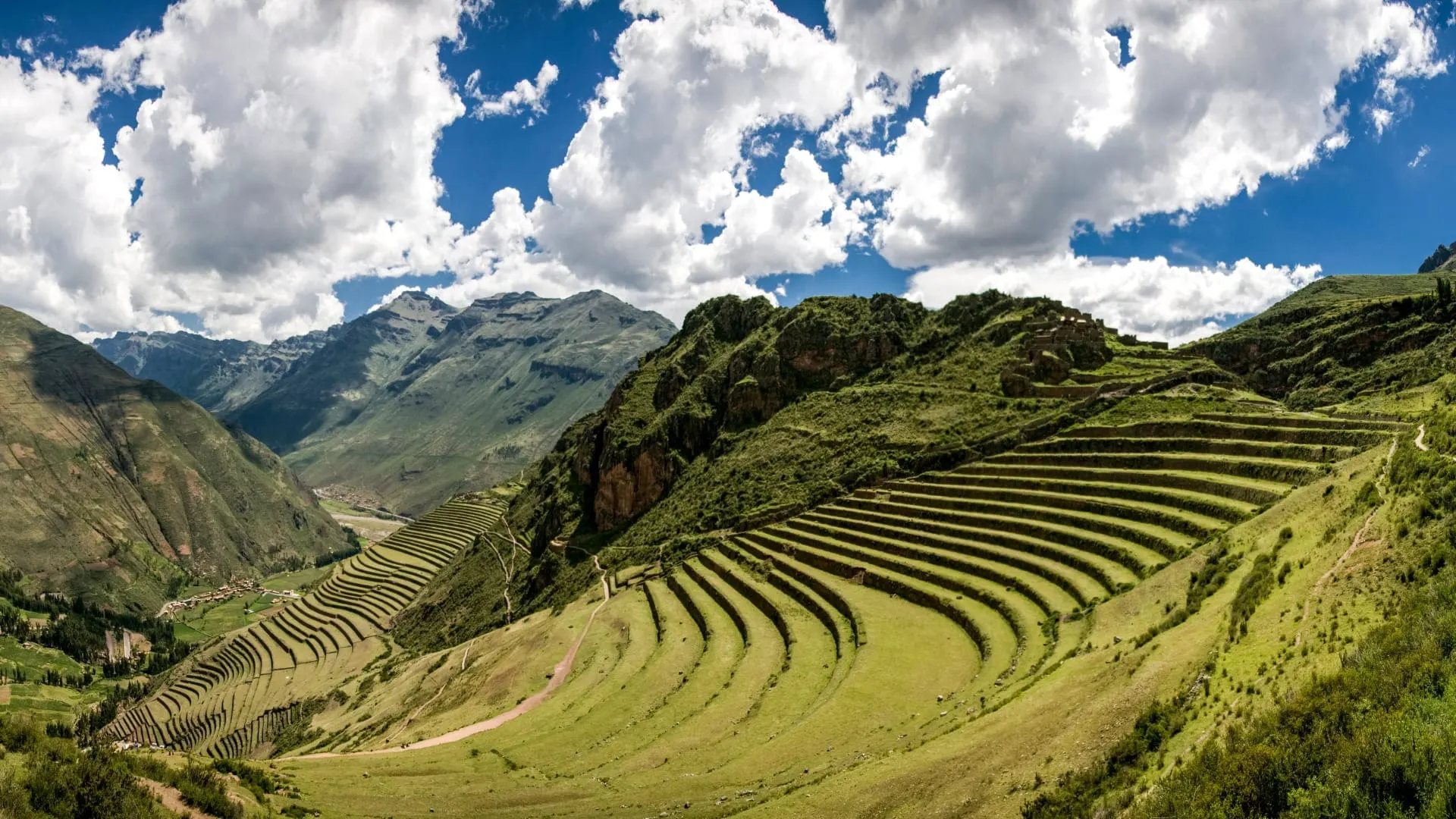
The Pisac ruins stretch along the ridge of the mountain, between two ravines. Research credits their planning to the Inca Pachacútec, in the 15th century. The names of the sectors aren’t the original Inca ones; they come from local tradition and later research.
| Sector | What it is | Don’t miss |
|---|---|---|
| Terraces | Curving farming terraces running down the slope | The panoramic view from the upper paths |
| Qantus Raqay | A sector of enclosures in the upper section, above the route to Paucartambo | Its commanding position over the valley |
| Qallaq’asa | A group of enclosures on the hillside | The passage between sectors, with walls and gateways |
| Intihuatana | Ceremonial sector with temples of fine stonework | The carved Intihuatana rock and the Temple of the Sun |
| Tankanamarka | Inca cemetery on the opposite slope | The tomb openings dotting the mountainside |
The Intihuatana and the ceremonial sector
This is the most refined part of the complex. Around a carved rock, the Intihuatana, stand enclosures of high-quality dressed stone, such as the so-called Temple of the Sun. According to RPP, the rock is aligned with the sunrise on the June solstice and was used to observe the sun and for ceremonies; it’s reminiscent of the Intihuatana at Machu Picchu.
Walls, tunnels and storehouses
The path between sectors runs through a wall with several gateways, one of them called Amaru Punku, the serpent gate, and through a tunnel cut into the rock. RPP also describes six qolqas, food storehouses, reached by a staircase, and some twenty towers along the edges of the mountain.
Tankanamarka, the Inca cemetery
Across the Kitamayu ravine, the mountainside is riddled with small holes. They’re Inca tombs, most of them looted in colonial times. RPP estimates there may have been about 10,000. You can’t go inside them, but you can see them clearly from the park’s paths.
How the park is laid out, from north to south
The Pisac mountain is hemmed in by two rivers that flow into the Vilcanota: the Kitamayo on the west and the Chongo on the east. A landscape archaeology study published in 2003 in the Boletín de Arqueología of the Pontifical Catholic University of Peru (PUCP) divides it into two main parts. To the north are Qallaq’asa, Antachaca and Qantus Raqay. To the south, Hospitalniyoc, Pisaqa, the Intihuatana and Inka Qonqorina. The same study counts a seventh group, Qanchisraqay, which some guides spell Kinchiracay. In the literature you’ll also see the cemetery spelled Tantanamarca.
The numbers explain why Pisac is so striking from afar. According to data from Santillana, who worked at the site in 1976 and 1977 and is cited in that study, there are 17 terrace sectors covering 65.5 hectares, while the seven groups of buildings take up only 4.3 hectares. Pisac is, above all, a landscape of terraces.
Pisaqa, Qantus Raqay and Qallaq’asa
- Pisaqa: it sits on a low, rounded part of the southern end of the mountain. Its buildings form a semicircle on three levels, and its terraces have polygonal stonework and entrances with gateways.
- Qantus Raqay: it occupies the tip of a spur on the eastern slope, farther north, also laid out in a semicircle and facing the Chongo valley. It has a fountain fed by a canal that draws water from the Kitamayo.
- Qallaq’asa: on the south it’s bounded by a geological fault that looks like a natural wall, and on the north by a great wall with the entrance called Amaru Punku.
The Mincetur inventory record adds two features you’ll see along the way: the towers, conical structures it classifies as dwellings or as lookouts, and the Acchapata terraces, 40 terraces that form an inverted triangle on the slope.
Water at the Intihuatana
Keep an eye on the canals. The PUCP study traces one that runs beneath the Tantanamarca tombs, crosses toward the Intihuatana and disappears near the Pisaqa terraces after a little over 1.1 km. In the Intihuatana sector it feeds seven fountains in all. For the authors, this canal links the cemetery, the temple and the lower part of the complex.
Fortress, royal estate or sanctuary?
No one knows for sure why Pisac was built. For a long time it was called a fortress, because of its walls and towers. Santillana interpreted it as a farming estate of the panaca, the royal lineage, of Pachacútec, and RPP presents it as the Inca’s royal estate. The 2003 study offers another reading: the temples, fountains and tombs point to a mainly sacred site. The authors themselves note that more excavation is needed to confirm it.
Tip: wear shoes with good grip and bring water. The park’s paths have long staircases, narrow stretches along the edge of the terraces and little shade. Allow at least two hours to see the main sectors without rushing.
Pisac by the numbers: official data
These figures come from the record for the Pisaq Archaeological Park in Mincetur’s Inventory of Tourism Resources, registered in September 2023, and from Cosituc, the committee that runs the Cusco Tourist Ticket.
| Item | Figure | Source |
|---|---|---|
| Cusco (Calle Puputi) – Pisac main square | 32.4 km, 48 min by minibus, paved road | Mincetur |
| Pisac main square – archaeological park | 9.3 km, 15 min by car | Mincetur |
| Elevation of the town | 2,972 m | Mincetur |
| Length of the route | Sights spread over 4 km | Mincetur |
| Opening hours | 7:00 a.m. to 6:00 p.m. | Mincetur |
| Legal status | Cultural Heritage of the Nation, R. D. N. 429/INC-2002 | Mincetur |
| Visitors in 2022 | 346,670 foreign and 226,490 Peruvian | Mincetur, with data from DDC Cusco |
| Ticket that covers it | Circuit III (Sacred Valley) or full Tourist Ticket | Cosituc |
You’ll see other distance figures: PromPerú, Peru’s tourism promotion board, says 33 km, for example. Mincetur’s 32.4 km measures the specific stretch from Calle Puputi to the Pisac main square. Elevation is similar: the same record lists 2,972 m, but its description puts the town at around 2,950 m and the archaeological sites at around 3,300 m.
How to get to Pisac from Cusco
- Colectivo or minivan: they leave from stops in downtown Cusco, mainly around Calle Puputi, and drop you in the town. The Mincetur record puts the minibus ride from Calle Puputi to the main square at 48 minutes. Check the current stop with your hotel.
- Taxi: the most comfortable option if you want to go straight to the upper part of the park and then walk down to the town.
- Sacred Valley day trip: almost all of them start in Pisac, with a visit to the ruins and a stop at the market.
Colectivos and taxis: what to know
Colectivos are how people in the valley get around, not a tourist service: they have no published timetable and you pay in cash, in soles. Bring coins and small bills. To get back to Cusco, it’s the same ride in reverse; ask in town where they’re stopping that day and don’t leave the return trip until after dark. If you take a taxi, agree on the price and the exact destination before you get in, especially if you want the driver to wait for you at the upper part of the park.
How to get up to the ruins from the town
There are two ways. By road, a route climbs from the town to the park’s upper entrance, and you do it by taxi. On foot, a steep trail climbs from the town between the terraces. The most comfortable combination is to go up by taxi and walk back down to the town, touring the park from top to bottom.
There’s no official published distance for the trail. What the Mincetur record does give is the difference in height: from the town, at around 2,950 m, to the archaeological sites, at around 3,300 m, it’s a climb of about 350 m. The road, which is longer because it goes around the mountain, adds up to 9.3 km between the main square and the park.
Important: the walk down to the town is long and has lots of steps. Only do it in daylight, with good shoes and water, and don’t start it late: according to the Mincetur record, the park closes at 6:00 p.m.
The Pisac market
The Pisac market fills the main square and the surrounding streets. According to Lonely Planet, it runs every day, and on Sundays producers from nearby communities join in with fruit, vegetables and other goods. You’ll find textiles, pottery, jewelry and souvenirs, as well as food stalls: Sacred Valley corn on the cob with cheese (choclo con queso) is a classic, as our guide to traditional Cusco food explains.
The tourist stalls mix local crafts with factory-made goods. If you’re looking for traditional weaving, ask about the material and the dyes, and compare before you buy. Friendly haggling is the norm.
Sunday, the big day
Sunday is the day the market changes. The Municipality of Pisac promotes the traditional Sunday market on Plaza Constitución, the town’s historic square, with producers from the district capital, the farming communities and neighboring districts selling what comes from their fields. According to PromPerú, barter, the exchange of goods between communities, also takes place in the main square that day. Several travel guides also name Tuesday and Thursday as busier days, but neither the municipality nor PromPerú publishes a calendar for those days: on weekdays, expect a smaller market.
Pisac entrance fee
The archaeological park is visited with the Cusco Tourist Ticket: there’s no individual ticket. According to Cosituc’s price list, the Sacred Valley partial ticket, which covers Pisac, Ollantaytambo, Chinchero and Moray, costs S/ 70 for foreigners and S/ 40 for Peruvians. The full ticket costs S/ 130 and S/ 70, and it’s valid for 10 days. You can buy it at the ticket office at the park itself. The town and the market are free to visit.
In Cosituc’s list of circuits, the Pisaq Archaeological Park is part of circuit III, the Sacred Valley circuit. That partial ticket is valid for 2 days for foreigners and 1 day for Peruvians, so it’s enough to see Pisac and Ollantaytambo one day and Chinchero and Moray the next. The opening hours recorded by Mincetur are 7:00 a.m. to 6:00 p.m.; check at the ticket office, since they can change.
Weather in Pisac and best time to go
The weather in Pisac is milder than in Cusco, because the town is lower. In the dry season, from May to September, the days are sunny and the nights cold; from December to March it rains often, especially in the afternoon, and the terraces are lush and green. Up at the ruins, which are higher, you feel the wind and the sun more. Month-by-month temperatures and rainfall are in our guide to Cusco weather.
For your visit, it’s best to arrive early, before the tour groups, or in the early afternoon, when many of them have already moved on to Urubamba.
The town of Pisac: square, church and traditions
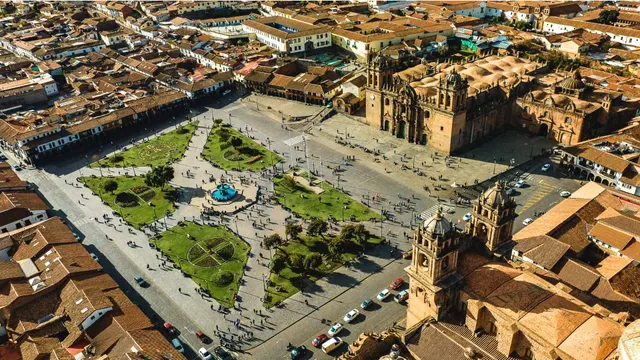
The town is laid out around Plaza Constitución. On the main square stands the church of San Pedro Apóstol, which, according to PromPerú, draws thousands of worshippers. It’s worth strolling its cobbled streets at an easy pace, especially after coming down from the ruins.
The varayoc and Sunday Mass
Pisac keeps its system of traditional authorities, the varayoc. In 2013 Peru’s Ministry of Culture declared it Cultural Heritage of the Nation, through Vice-Ministerial Resolution 026-2013-VMPCIC-MC, as reported by Andina. There are nine positions, from the cañari up to the alcalde or varayoq, who carries a staff more than a meter long; together they’re called the kuraqkuna. Their public presentation, the wachu, takes place at Catholic celebrations such as Sunday Masses. If you go on a Sunday, you may see them with their staffs at the church and in the square.
The Virgen del Carmen festival
Pisac’s big festival is held from July 15 to 18, according to Andina, with a serenade and castle-shaped fireworks, a procession and traditional dances. The Virgin is dressed as a princess and carries the “parasol del inca,” decorated with macaw feathers. In 2014 the Ministry of Culture declared it Cultural Heritage of the Nation (Vice-Ministerial Resolution 006-2014-VMPCIC-MC). The resolution explains that devotion to the Virgen del Carmen arrived in the late 19th century and displaced San Pedro Apóstol as the town’s patron, and that stewards (mayordomos), brotherhoods, musicians, dancers and the district’s twelve farming communities all take part. If you’re traveling on those dates, book your lodging early.
Things to do in Pisac
- Explore the archaeological park, from the upper sector to the Intihuatana.
- See the Tankanamarka tombs from the paths.
- Walk down through the terraces to the town.
- Stroll around the market and the main square, ideally on a Sunday.
- Go on a Sunday, when the varayoc attend Mass with their staffs.
- Visit the Potato Park (Parque de la Papa), an initiative of five communities that, according to PromPerú, protects potato varieties and traditional farming techniques.
- Spend the night in town to acclimatize before Cusco or Machu Picchu.
How much time should you spend in Pisac?
Half a day is enough to see the essentials: about two hours in the archaeological park, the walk or ride down to the town and an hour at the market. On a full-day trip, the stop is usually shorter, so prioritize the Intihuatana sector and leave the market for the end. If you’re staying in town, you can go up to the ruins first thing in the morning, when the park is almost empty, and spend the afternoon at the market and resting. If you’re coming from Cusco, also spelled Cuzco, you can do Pisac as a standalone half-day trip and be back in the city by the afternoon.
Pisac on your Sacred Valley route
Pisac is the natural starting point of the valley from Cusco. From here, the road follows the valley floor toward Calca, Urubamba and Ollantaytambo, and the return trip usually goes through Chinchero. If you have two days, save the Maras and Moray plateau for the second one.
Half-day plan from Cusco
- Leave early from the Calle Puputi area: it’s about 48 minutes to the Pisac main square.
- Take a taxi up to the park’s upper entrance: 9.3 km and about 15 minutes.
- Tour Qantus Raqay, Qallaq’asa and the Intihuatana, looking across the ravine at Tankanamarka.
- Walk down through the terraces to the town or ride back by taxi.
- Finish at the market and the square, and head back to Cusco before dark.
One-day Sacred Valley plan
- In the morning, Pisac: the park first and then the market.
- Continue along the valley floor, through Calca and Urubamba, to Ollantaytambo, and visit its archaeological park in the afternoon.
- Return to Cusco through Chinchero, with a stop if there’s still daylight.
- If you’re a foreigner, the circuit III partial ticket lasts two days: save Chinchero and Moray for the next day.
Summary: Pisac for your trip
- You have half a day: colectivo from Calle Puputi (about 48 minutes), taxi to the upper section, tour of the ruins and walk down to the market.
- You’re doing the Sacred Valley in one day: Pisac will be your first stop; buy the circuit III ticket there if you don’t have one yet.
- You’re looking for a quiet place to stay: the town is smaller and calmer than Urubamba.
- You’re into crafts or living culture: go on a Sunday, for the Sunday market and the varayoc, or from July 15 to 18, for the Virgen del Carmen.
The next step is to plan the rest of your trip: our 3-, 5- and 7-day Cusco itinerary shows how to combine Pisac with the city of Cusco and Machu Picchu.
Frequently asked questions
What is the elevation of Pisac?
The town is at 2,972 m, about 400 m lower than Cusco. The archaeological park is higher: its terraces reach about 3,450 m.
How do you get from Cusco to Pisac?
By colectivo or minivan from the Calle Puputi area, by taxi or on a Sacred Valley day trip. According to Mincetur it’s 32.4 km, about 48 minutes to the Pisac main square.
What days is the Pisac market open?
It runs every day in the main square and the surrounding streets. Sunday is the big day, when producers from the communities come to the Sunday market on Plaza Constitución.
How much does it cost to enter the Pisac ruins?
There’s no individual ticket: you need the Cusco Tourist Ticket. The Sacred Valley partial ticket costs S/ 70 for foreigners and the full ticket S/ 130, according to Cosituc.
Which Cusco Tourist Ticket circuit includes Pisac?
Circuit III, the Sacred Valley circuit, along with Chinchero, Moray and Ollantaytambo. That partial ticket is valid for 2 days for foreigners and 1 day for Peruvians.
What are the opening hours of the Pisac ruins?
Mincetur’s tourism inventory record lists 7:00 a.m. to 6:00 p.m., year-round. Check at the ticket office and don’t start the walk down late.
Can you hike up to the Pisac ruins?
Yes, on a steep trail between the terraces that starts in the town, with about 350 m of elevation gain. The most comfortable option is to take a taxi to the upper entrance, 9.3 km by road, and walk back down.
What are the sectors of the Pisac ruins?
A PUCP study counts seven groups of buildings: Intihuatana, Inka Qonqorina, Pisaqa, Qantus Raqay, Qallaq'asa, Hospitalniyoc and Qanchisraqay. On top of those come the terraces and the Tankanamarka cemetery.
How much time do you need to visit Pisac?
Half a day: about two hours for the archaeological park and another hour for the town and the market.
Who are the varayoc of Pisac?
They’re the district’s traditional authorities, with nine positions and a staff as their symbol. Their system was declared Cultural Heritage of the Nation in 2013, and they appear at Sunday Masses.
When is the Virgen del Carmen festival in Pisac?
From July 15 to 18, with a procession, dances and fireworks. It has been Cultural Heritage of the Nation since 2014.
Is it Pisac, Písac or Pisaq?
They’re different spellings of the same place. Pisac is the most common; Pisaq is closer to the Quechua spelling.
Official sources
- Mincetur, Inventory of Tourism Resources: Pisaq Archaeological Park (elevation, sectors, hours, visitors and access routes) consultasenlinea.mincetur.gob.pe
- Cosituc: Cusco Tourist Ticket price list cosituccusco.pe
- Cosituc: Tourist Ticket circuits (Pisaq in circuit III) cosituccusco.pe
- Municipality of Pisac: the traditional Sunday market (2025) munipisac.gob.pe
- Lonely Planet: Pisac craft market lonelyplanet.com

How we put this guide together
Written by Paul Pumalloclla · 17 years in tourism
- Official sources Prices, opening hours and rules checked against Peru’s Ministry of Culture, SERNANP, PromPerú and the train and bus operators.
- Sources cited Every guide links to the sources we used at the end.
- Always up to date When a rule changes, we update the guide and its date.
We’re not a travel agency: we don’t sell tours or take bookings. If a link belongs to a commercial partner, we label it next to the link, and that never changes the facts or the recommendations.
Guide history
- Published
- Last reviewed
Spotted something out of date?
Let us know and we’ll check it against the official source.
Report a change