
Key facts
- Raqchi is a 15th-century Inca complex famous for the Temple of Wiracocha, one of the largest roofed buildings in the Inca world.
- It’s in the district of San Pedro, province of Canchis, about 120 km southeast of Cusco, right on the road to Puno.
- It sits at about 3,460 m, just above the city of Cusco.
- It takes 2 h to 2 h 30 min on a paved road; it’s a regular stop for Cusco–Puno tourist buses.
- It has its own entrance fee, separate from the Cusco Tourist Ticket: bring cash in soles.
Raqchi is an Inca archaeological site in southern Cusco famous for the Temple of Wiracocha, one of the largest roofed buildings the Incas ever built. It’s in the district of San Pedro, province of Canchis, about 120 km from the city of Cusco and at an elevation of about 3,460 m, right on the road to Puno. You can see it in one or two hours, and it’s usually combined with the South Valley on the overland trip between Cusco and Lake Titicaca.
What is Raqchi?
The Raqchi Archaeological Park is a 15th-century Inca complex made up of a great temple, residential enclosures, plazas and dozens of circular storehouses. According to Peru’s Ministry of Culture, it was built over almost that entire century, during the reigns of Wiracocha, Pachacútec and Túpac Yupanqui. It was a monumental tambo, or way station, on the Inca road linking Cusco with the Collao, the Titicaca plateau: a place of worship, rest and food storage.
Next to the ruins lives the Raqchi community, known for its pottery. On the town square there’s a colonial church of adobe and stone, and you’ll usually find craft stalls at the entrance to the site. In search engines it also shows up as “Rachi” or “Raqch’i”: it’s the same place.
Where is Raqchi and what is its elevation?
Raqchi is in the Vilcanota River valley, in the province of Canchis, southeast of Cusco. By road it’s about 120 km, a trip of 2 h to 2 h 30 min depending on traffic and stops. PromPerú gives the distance as 117 km. The nearest large town is Sicuani, the provincial capital, a little farther south on the same road.
Raqchi’s elevation is around 3,460 m, just above Cusco (about 3,399 m). The figures vary a bit depending on the source and the exact point measured. If you’ve already spent a couple of days in Cusco, the altitude shouldn’t be a problem; if you’ve just arrived, walk slowly and read our guide to altitude sickness in Cusco.
The Temple of Wiracocha
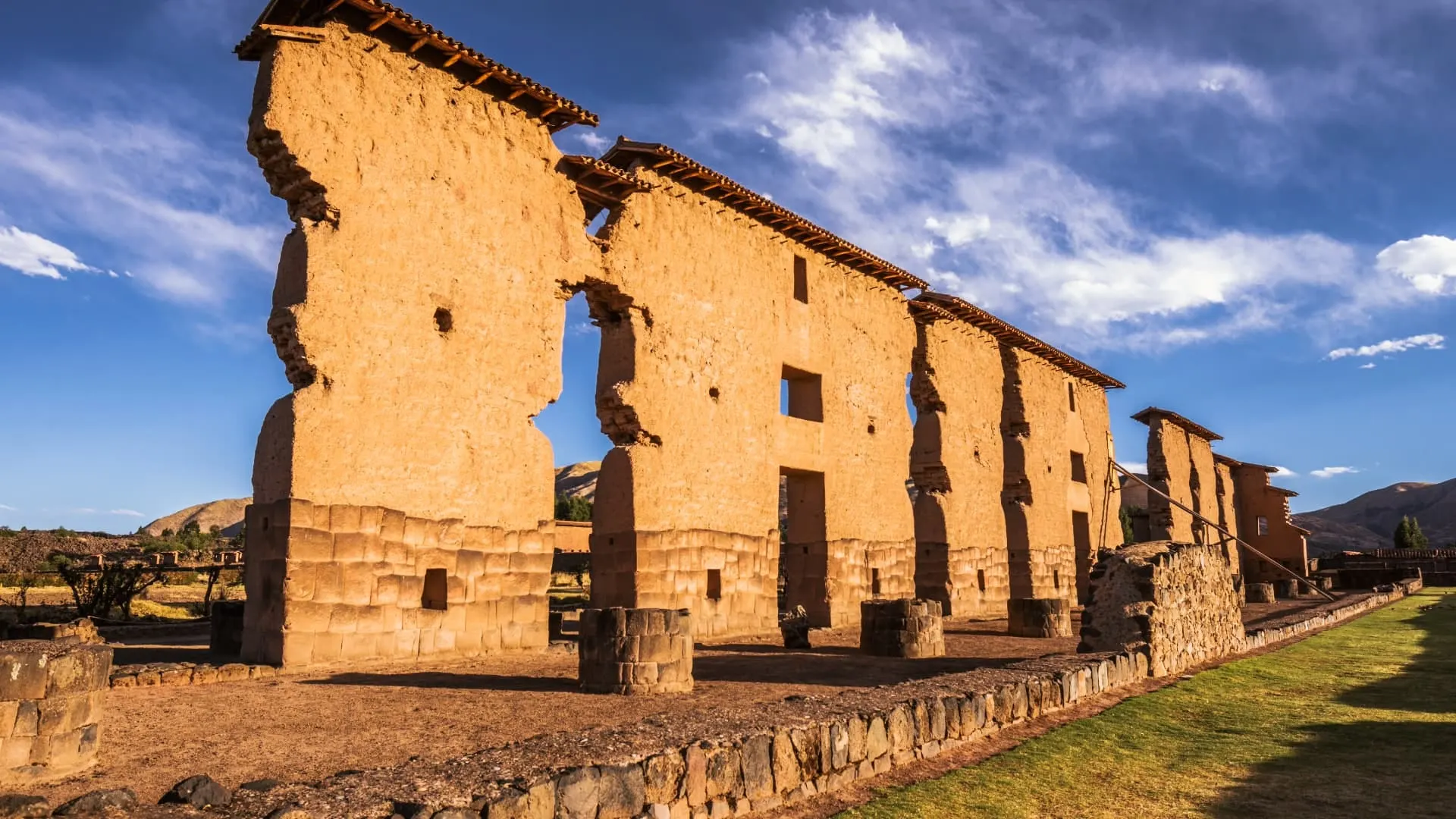
The Temple of Wiracocha is the main reason to come to Raqchi. It was a kallanka, a large roofed rectangular hall. PromPerú credits it with a length of about 100 m and a width of 20 m; the most widely cited archaeological measurements put it at about 92 by 25 m. Whatever the exact figure, it’s one of the largest roofed buildings in the Inca world.
The most striking feature is the central wall: a base of volcanic stone topped by an upper section of adobe that still rises more than 12 m, with walls up to 14 m high according to PromPerú. That wall supported the gabled roof. On each side stood a row of cylindrical columns of stone and adobe, of which the bases and a few standing columns remain. The walls have Inca-style windows and openings that give you a sense of the hall’s original size.
The Spanish chroniclers already described it as one of the boldest Inca buildings. What you see today is what survived after the roof and part of the walls were lost following the conquest.
Tip: walk around both sides of the temple. From outside, you get a better sense of how tall the central wall is, and from inside, the scale of the hall. In the morning light, the adobe shows more contrast.
What to see at Raqchi
Besides the temple, the park has several sectors that you visit on the same circuit:
- The qolqas: rows of circular stone storehouses where corn, freeze-dried potatoes and other goods were kept. Peru’s Ministry of Culture restored this sector between 2017 and 2022, including 118 circular structures, seven rectangular ones and their streets.
- The nobility’s enclosures: rectangular dwellings arranged around courtyards, next to the temple.
- The streets and the central space: the orderly layout of long and cross streets that links the qolqas with the rest of the complex.
- The town and its church: the Raqchi town square, the colonial church and the pottery workshops.
Allow an hour to an hour and a half, and a bit more for the pottery workshops.
How to get to Raqchi from Cusco
Raqchi is right on the paved Cusco–Puno highway, so it’s easy to reach. These are the usual options:
| Option | Time from Cusco | Best for |
|---|---|---|
| Cusco–Puno tourist bus with stops | Full day to Puno, with a stop at Raqchi | Travelers continuing to Lake Titicaca who want to see the south along the way |
| Day trip through southern Cusco | Full day, round trip | Travelers returning to sleep in Cusco who want to add Andahuaylillas or Tipón |
| Private car or taxi | About 2 h to 2 h 30 min each way | Small groups who want to stop at their own pace |
| Regular Cusco–Sicuani bus | About 2 h 30 min to 3 h to the turnoff, plus the last local stretch | Independent travelers with time to spare |
If you’re taking a regular bus, ask the driver to drop you at the Raqchi turnoff and do the last stretch by mototaxi or local colectivo; confirm the drop-off point before you board. To get back, buses to Cusco run along the same road, but less often in the late afternoon.
If you’re coming from Lima or traveling southern Peru overland, our guide on how to get from Lima to Cusco explains the route via Arequipa and Puno, which passes Raqchi.
Raqchi on the route from Cusco to Puno
The road from Cusco to Puno is one of the most scenic in the southern Andes, and Raqchi is its main stop. On the same route you can see:
- Tipón: Inca terraces and channels, about 23 km from Cusco.
- Pikillacta: the Wari city, older than the Incas, about 30 km away.
- Andahuaylillas: the church known as the “Sistine Chapel of the Americas,” about 40 km away.
- Raqchi: the Temple of Wiracocha, about 120 km away.
- La Raya pass: the highest point on the route, on the border with Puno, with views of snowcapped peaks.
If you’re heading back to sleep in Cusco, a good combination is Andahuaylillas in the morning and Raqchi at midday. The whole area close to the city is covered in our guide to the South Valley of Cusco. And if you’re looking for colorful mountains, Palcoyo and Rainbow Mountain are also in the province of Canchis, though on a separate trip.
Raqchi admission: price and opening hours
Raqchi isn’t part of the Cusco Tourist Ticket: it has its own entrance fee, paid on site. PromPerú lists reference prices of S/ 20 for adults, S/ 7 for students and S/ 5 for schoolchildren, with opening hours from 7:00 a.m. to 6:00 p.m. These are reference rates and may change.
Important: bring cash in soles. You can’t always pay by card at the site or in the town, and it’s best not to count on ATMs. If you’re on a tourist bus, ask whether the entrance fee is included in the price.
Weather and best time to visit Raqchi
Raqchi’s weather is similar to Cusco’s: sunny days and cold nights. PromPerú gives a low of 1 °C and a high of 20 °C. The dry season, from May to September, brings clear skies and the best light for photographing the temple; from December to March it often rains in the afternoon, although you can still visit the site. You’ll find month-by-month details in our guide to Cusco weather.
If you’re traveling in June, keep in mind the Raqchi Festival, held on the third Sunday of June with dances and music by the area’s communities. It falls during the weeks of Inti Raymi in Cusco, so it’s a good idea to plan your transportation well ahead.
Tips for visiting Raqchi
- Sunscreen, a cap and water: there’s almost no shade between the sectors.
- A light jacket even if it’s sunny: the wind in the valley cools things down fast.
- Comfortable shoes: the ground is uneven, with loose stones in the qolqas area.
- Respect the ropes and signs: don’t climb on the walls or the storehouses.
- Try something along the way: the chicharrón in Saylla and the bread in Oropesa are on the same road. More ideas in our guide to traditional Cusco food.
Summary: is Raqchi worth visiting?
Raqchi is worth it if you’re interested in Inca architecture beyond Machu Picchu or if you’re already traveling overland to Puno: it’s the best stop on the route. As a standalone day trip from Cusco, it makes more sense if you combine it with Andahuaylillas and the South Valley on the same day. To fit it into your trip, check our 3-, 5- and 7-day Cusco itineraries and our guide to the Cusco trip budget. Other uncrowded places in the south of the region are Waqrapukara and the Q’eswachaka bridge.
Frequently asked questions
Where is Raqchi?
In the Raqchi community, district of San Pedro, province of Canchis, in the Cusco region. It’s in the Vilcanota valley, about 120 km southeast of the city, right on the road to Puno.
What is the Temple of Wiracocha?
It’s a large Inca kallanka, a roofed rectangular hall about 90 to 100 m long. It keeps its central wall of stone and adobe, more than 12 m high, and the bases of the columns that held up the roof.
How much is the entrance fee for Raqchi?
PromPerú lists reference prices of S/ 20 for adults, S/ 7 for students and S/ 5 for schoolchildren. It’s paid on site, in cash, and isn’t included in the Cusco Tourist Ticket.
How long does it take to get from Cusco to Raqchi?
Between 2 h and 2 h 30 min by car or bus along the road to Puno. A regular bus to Sicuani takes a bit longer, because you have to cover the last stretch from the turnoff.
What is the elevation of Raqchi?
About 3,460 m above sea level, almost the same as Cusco. If you’ve already spent a couple of days in the city, you won’t notice much difference.
How much time do you need to visit Raqchi?
An hour to an hour and a half for the temple, the qolqas and the enclosures. Add a bit more if you want to see the town’s pottery workshops.
What can you see on the way from Cusco to Raqchi?
Tipón, Pikillacta and the church of Andahuaylillas, in the South Valley. If you continue to Puno, La Raya pass is the highest point on the route.
When is the Raqchi Festival?
It’s held on the third Sunday of June, with music and dances by the area’s communities, according to PromPerú.
Official sources
- PromPerú (Y tú qué planes): Raqchi Archaeological Park ytuqueplanes.com

How we put this guide together
Written by Paul Pumalloclla · 17 years in tourism
- Official sources Prices, opening hours and rules checked against Peru’s Ministry of Culture, SERNANP, PromPerú and the train and bus operators.
- Sources cited Every guide links to the sources we used at the end.
- Always up to date When a rule changes, we update the guide and its date.
We’re not a travel agency: we don’t sell tours or take bookings. If a link belongs to a commercial partner, we label it next to the link, and that never changes the facts or the recommendations.
Guide history
- Published
- Last reviewed
Spotted something out of date?
Let us know and we’ll check it against the official source.
Report a change
