Key facts
- A living Inca town and a major archaeological park at the end of the Sacred Valley, with the six-monolith Temple of the Sun.
- It’s in the province of Urubamba, about 72 km from Cusco via Chinchero (71.8 km according to Mincetur), about 1 h 45 min, and at an elevation of 2,792 m.
- Most PeruRail and Inca Rail trains to Aguas Calientes leave from its station, a 1 h 30 min to 2 h ride.
- You get there by road in a colectivo, taxi or day trip; PeruRail’s bimodal service combines bus and train.
- The archaeological park is visited with the Cusco Tourist Ticket, either the full ticket or the Sacred Valley partial ticket.
- The park is open from 7:00 a.m. to 4:30 p.m., according to Mincetur; across the valley, the Pinkuylluna storehouses are free to enter.
Ollantaytambo is an Inca town and a major archaeological site at the far end of the Sacred Valley in Cusco, Peru, 72 km from the city of Cusco and at an elevation of 2,792 m. Its fortress, crowned by the six-monolith Temple of the Sun, towers over a town that still uses its Inca streets and water channels. On top of that, most trains to Machu Picchu leave from its station.
What is Ollantaytambo?
It’s two things you visit together. On one hand, there’s the Ollantaytambo Archaeological Park: Inca terraces, temples, fountains and storehouses on the hillside above the town. According to Andina, the park covers some 34,800 hectares with 204 sites, although what visitors actually see is the monumental zone, about 18 hectares, managed by Peru’s Ministry of Culture. On the other hand, there’s the town itself: one of the few settlements of Inca origin that are still inhabited, with its original grid of blocks and irrigation channels.
That’s why many people call it a “living Inca town.” It isn’t an open-air museum: people live, farm and sell their goods on the same streets that were laid out more than five centuries ago.
Where is Ollantaytambo and what is its elevation?
Ollantaytambo is in the province of Urubamba, at the northwestern end of the Sacred Valley, where the valley starts to narrow toward the cloud forest and Machu Picchu. From the city of Cusco it’s about 72 km along the road through Chinchero and Urubamba (71.8 km according to the town’s record in the tourism inventory of Mincetur, Peru’s Ministry of Foreign Trade and Tourism), around 1 h 45 min.
Ollantaytambo’s elevation is 2,792 m, about 600 m lower than Cusco. That’s one of the reasons so many travelers spend their first nights here: it’s easier to acclimatize than in the city. If you’ve just arrived in the region, read our guide to altitude sickness in Cusco.
The Ollantaytambo ruins: what to see
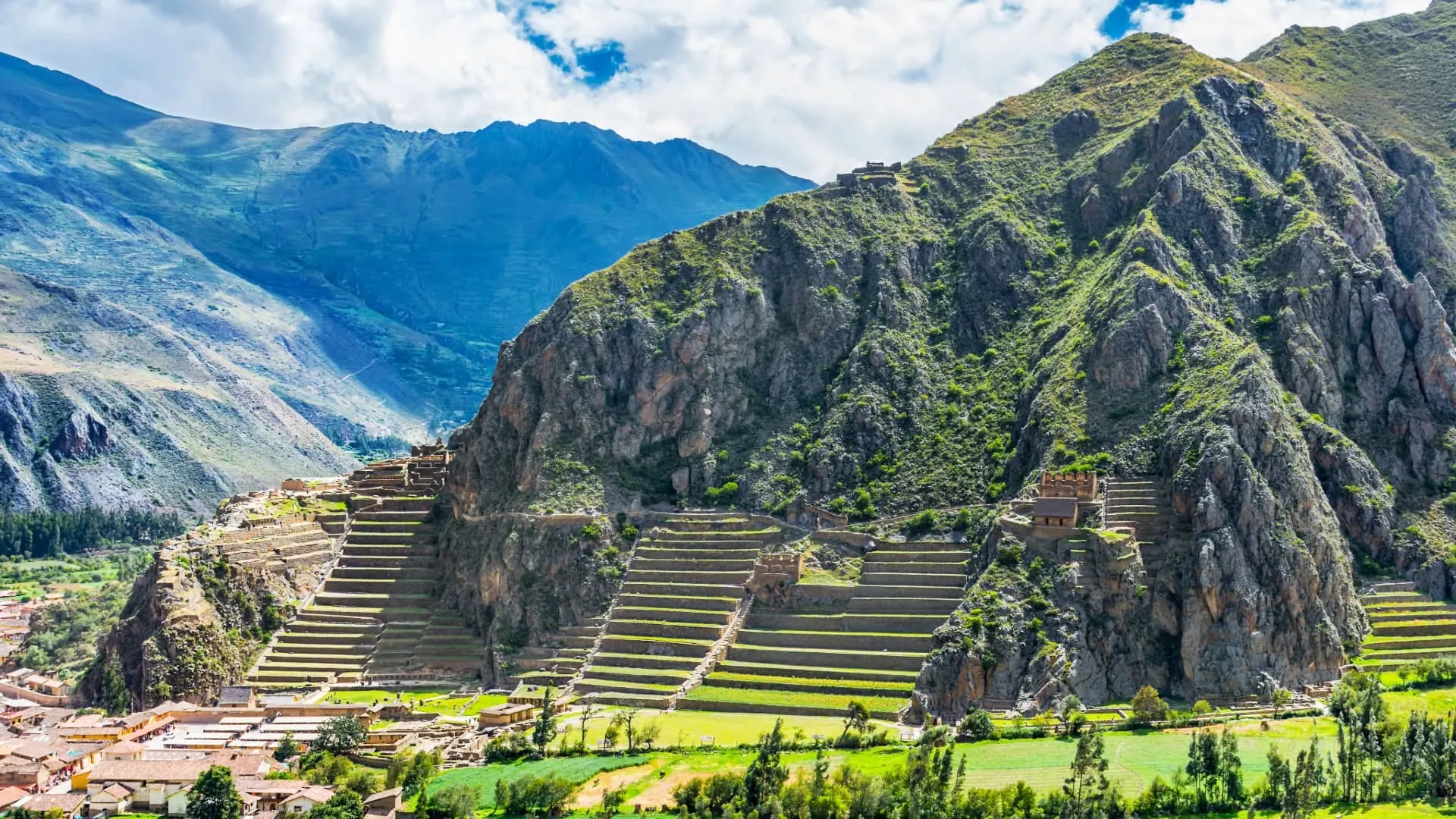
A visit to the Ollantaytambo archaeological complex climbs a great staircase between terraces to the upper section, where the temples are, and comes back down through the water sectors. According to Andina, most visitors stay for about two hours. These are the main sectors:
- The terraces: the farming terraces that climb the hillside and make up the site’s best-known image.
- The Temple of the Sun: at the top, a wall of six polished stone monoliths, between 3.32 and 4.20 m tall, with geometric reliefs. It faces the sunrise.
- The Ten Niches: an Inca wall with trapezoidal niches, typical of ceremonial enclosures.
- Other sectors: the Inca Watana, the Inca Misana and the military zone complete the complex.
- The Princess Bath (Baño de la Ñusta) and the Ceremonial Fountain: in the lower section, carved fountains where the water still flows.
- The qolqas: food storehouses built on the slopes.
What amazes people most is the stone. The blocks of the Temple of the Sun are pink rhyolite and, according to Andina, they come from the Cachiccata quarry, about 4 km away, high up on the far bank of the river. Moving them here, across the river and up the slope, is one of the great puzzles of Inca engineering. Abandoned blocks still lie along the way, the so-called “tired stones.”
The park’s record in Mincetur’s tourism inventory adds more detail about the route. The staircase to the upper section takes 20 to 30 minutes to climb, with the straight, wide terraces on your right, facing the square. Near the top is the Ten Niches enclosure, which leads into the Temple of the Sun, and its monoliths are carved with stepped crosses, or chakanas. Down below, the Princess Bath is the best-known fountain: water flows year-round, in both the dry and rainy seasons, and it bears the stepped motif known as pata pata. According to Andina, it’s carved from a single stone.
Tip: climb up to the Temple of the Sun first, while you have the most energy and before the mid-morning groups arrive, and save the fountains for the way down. The staircase is steep and has no shade: bring water and sunscreen.
Ollantaytambo archaeological park opening hours
According to Mincetur’s record, updated in 2024, the park is open every day of the year from 7:00 a.m. to 4:30 p.m. At the entrance there’s a ticket office, guide services and viewpoints. Cusco residents get in free with their national ID. It’s one of the most visited sites in the region: in 2023 it received 290,655 foreign visitors and 253,182 Peruvians, according to figures from the Decentralized Culture Office (DDC) of Cusco compiled by Mincetur.
The Inca town of Ollantaytambo
Take your time wandering through the old quarter, north of the main square. The streets are narrow, with Inca stone walls at their base and water channels running alongside the sidewalks. Many houses keep the structure of Inca canchas, enclosures with a shared courtyard and a single entrance from the street.
The canchas and the two neighborhoods
The Patacancha stream splits the town into two neighborhoods. According to Andina, Qosqo Ayllu, to the east, holds the central square, and Araqama Ayllu, to the west, is where the archaeological park lies. The streets form 15 blocks, or “canchas.” The town’s record in Mincetur’s inventory notes that both neighborhoods are preserved and still used by local residents. It also says construction began under Pachacútec, continued under Túpac Inca Yupanqui and Huayna Cápac for about 61 years, and was left unfinished because of the Inca civil war and the arrival of the Spanish.
South of the town lies an intangible agricultural zone, meaning a protected one, of terraces and farm fields, which is also home to the archaeological site of Qellu Raqay.
Pinkuylluna, the storehouses on the opposite slope
Across from the fortress, on Pinkuylluna hill, you can see structures clinging to the mountainside. They’re colcas, Inca storehouses: Andina describes eight granaries where remains of grains and tubers have been found. A trail climbs up to them from the town. It’s steep and narrow, but the view of the town and the fortress from the top is worth the effort if you have time and good balance.
The climb is free: according to its record in Mincetur’s tourism inventory, Pinkuylluna has free entry and isn’t part of the Tourist Ticket. It’s about 300 m from the town, some 20 minutes on foot, and the listed hours are 7:30 a.m. to 4:30 p.m. The record describes two sectors. The one closest to the town has 12 rectangular rooms on platforms; the second, three long two-story buildings with windows and ventilation openings, next to eight small terraces. At the start of the climb there are also old lookout posts, used to watch who was approaching along the valley.
History of Ollantaytambo
The area was settled before the Incas, but the great complex you see today is Inca. Its transformation is credited to Pachacútec, in the 15th century, as part of the valley’s royal estates. The chronicler Inca Garcilaso de la Vega described it as a garden and a place of leisure. The name is also linked to Ollantay, the general who is the hero of the colonial Quechua drama that bears his name.
Ollantaytambo played a key role in the resistance against the Spanish. In January 1537, Manco Inca’s troops defeated those of Hernando Pizarro here, one of the few Spanish defeats of the conquest. Shortly afterward, with Spanish reinforcements on the way, Manco Inca withdrew to Vilcabamba, in the jungle, where he kept an independent Inca state going for decades. For the background, read our guide to Inca history and culture.
Recent recognition
In recent years, Ollantaytambo has collected distinctions that explain its fame. According to Andina, UN Tourism named it one of its “Best Tourism Villages” in 2021; on September 17, 2022, Mincetur named it Peru’s first “Pueblo con Encanto” (charming town), and The New York Times included it among its 52 places to go in 2025. In Mincetur’s tourism inventory, the town holds hierarchy 4, the highest level, which according to Andina only eleven tourist attractions in the country share.
How to get to Ollantaytambo from Cusco
You reach Ollantaytambo by road from Cusco, or by train from Machu Picchu. These are the options:
| Option | From | Approximate time | Best for |
|---|---|---|---|
| Colectivo or shared minivan | Stops in downtown Cusco, mainly on Calle Pavitos | 1 h 45 min to 2 h | Independent travelers on a tight budget |
| Taxi or private car | Your hotel in Cusco or the airport | 1 h 45 min | Groups, families and anyone with luggage |
| Sacred Valley day trip | Cusco, with hotel pickup | Full day | Travelers who also want to see Pisac and Chinchero |
| PeruRail bimodal service | Wanchaq station, in Cusco | 4 h to 4 h 40 min to Machu Picchu, switching from bus to train in Ollantaytambo or Pachar | Travelers heading straight to Machu Picchu |
| Return train | Aguas Calientes | 1 h 30 min to 2 h | Travelers coming back from Machu Picchu |
Via Chinchero or via Pisac: distances and times
Two paved roads link Cusco with Ollantaytambo. The one through Chinchero and Urubamba crosses the plateau and is the most direct. The Pisac road drops into the valley and follows it downstream through Calca and Urubamba; it’s longer, but it passes more towns and many day trips use it. These are the stretches according to the records in Mincetur’s tourism inventory, rounded. They’re driving times, not counting stops or traffic.
| Route | Stretch | Approx. km | Driving time |
|---|---|---|---|
| Via Chinchero | Cusco → Chinchero | 30 km | 35 min |
| Via Chinchero | Chinchero → Urubamba | 21 km | 20 min |
| Via Chinchero | Urubamba → Ollantaytambo | 19 km | 30 min |
| Via Pisac | Cusco → Pisac | 32 km | 48 min |
| Via Pisac | Pisac → Ollantaytambo, via Calca and Urubamba | 58 km | 1 h 30 min |
In total, it’s about 70 km via Chinchero and about 90 km via Pisac. If you want to see the valley without repeating a road, go one way and come back the other, as in the one-day route in our Sacred Valley guide.
Bus and colectivo from Cusco to Ollantaytambo
Colectivos and minivans leave when they fill up and go via Chinchero. Some go straight to Ollantaytambo and others end in Urubamba, where you catch another colectivo for the last stretch. Fares and stops change, so ask at your hotel. Pack light: there’s very little room.
Mincetur’s records use Calle Pavitos as the starting point for the Chinchero route, with a 1 h 30 min ride to Ollantaytambo’s main square, and Calle Puputi for vehicles heading to Pisac. If you choose Pisac, expect to change vehicles at least once, in Pisac or in Urubamba.
Taxi and private transfer
A taxi or a car with a driver is the most flexible option: you can stop in Chinchero or at viewpoints along the way and leave whenever you like. Agree on the price and the route before you get in, book the taxi through your hotel or a registered company, and avoid unmarked cars offering rides on the street. If you’re heading to the station, ask to be dropped off on Avenida Ferrocarril and leave extra time for traffic around train departure times.
Is there a train from Cusco to Ollantaytambo?
It isn’t a practical way to cover that stretch. The trains are designed to take you to Machu Picchu: from Cusco, PeruRail runs trains from Poroy in some months and, the rest of the year, the bimodal service, with a bus to Ollantaytambo or Pachar and a train from there. If you only want to get to Ollantaytambo, go by road.
Ollantaytambo train station
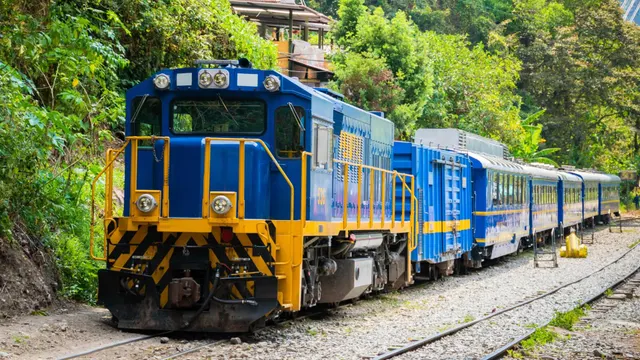
Ollantaytambo train station is in the lower part of town, next to the river. It’s the departure point with the most schedules to Aguas Calientes, the town at the foot of Machu Picchu, served by two companies: PeruRail and Inca Rail. The ride takes 1 h 30 min to 2 h.
The station is on Avenida Ferrocarril, with no street number. According to Mincetur’s tourism inventory, from here to Machu Picchu Pueblo, the official name of Aguas Calientes, there are 43 km of track. It’s best to buy your ticket in advance, especially in high season. If you’re looking for a cheaper alternative without the train from here, the Hidroeléctrica route combines road and hiking.
- Arrive early: both companies ask you to be there at least 30 minutes before departure, with your passport and ticket.
- PeruRail luggage storage: free, at Ollantaytambo station, from 4:15 a.m. to 9:00 p.m.
- Pachar station: since September 1, 2025, some bimodal departures switch from bus to train in Pachar, before Ollantaytambo. Your ticket shows the station.
- Traffic: the access street to the station gets congested around departure times; if you’re going by taxi, leave plenty of time.
Schedules, train classes and luggage allowances are in our guide to the train to Machu Picchu. If you haven’t decided how to go yet, compare all the options in how to get to Machu Picchu.
Ollantaytambo entrance fee
The archaeological park doesn’t sell individual tickets: you visit it with the Cusco Tourist Ticket. According to Cosituc’s price list, the Sacred Valley partial ticket, which covers Ollantaytambo, Pisac, Chinchero and Moray, costs S/ 70 for foreigners and S/ 40 for Peruvians, and it’s valid for 2 days for foreigners. The full ticket costs S/ 130 and S/ 70, and it’s valid for 10 days.
Important: you can buy the ticket at the ticket office at the site itself, but its validity starts on the day of purchase. If you’re using the 2-day partial ticket, buy it on the day you start touring the valley, not the day before.
The student ticket is for people aged 10 to 17 with their ID, and 18 to 25 with a valid student card or ISIC card, according to Cosituc. For now it’s sold in person, at the site’s ticket office or at Cosituc’s offices in Cusco, not online. In August 2026, Cosituc reported a new Tourist Ticket law that provides for gradually introducing a digital ticket, so check its website before you travel.
Things to do in Ollantaytambo
- Climb to the Temple of the Sun and walk the terraces of the archaeological park.
- See the fountains and the Princess Bath, in the lower section.
- Stroll the Inca streets of the old quarter, with their water channels.
- Hike up to the Pinkuylluna storehouses to see the town from above.
- Take the train to Aguas Calientes and spend the night at the foot of Machu Picchu.
- Start a trek: the Inca Trail begins at km 82, nearby, and the Lares trek ends in Ollantaytambo.
Festivals in Ollantaytambo
The town has its own calendar. The biggest festival honors the Señor de Choquekillka, the district’s patron, and lasts four days around Pentecost. Since Pentecost falls seven weeks after Easter Sunday, the date changes every year and usually lands between May and June. According to Mincetur’s record, at least 300 dancers take part in more than 16 dances, and on the last day the meal offered to the Señor is shared with the whole town. Andina notes that the festival has been Cultural Heritage of the Nation since June 2017.
- Ollantay Raymi, June 29: a staging of the Ollantay drama in the town and at the fortress.
- Bajada de Reyes, in January, and the festival of the Niño Melchor de Marcacocha, in February: traditional festivals in the district, according to Mincetur.
- Wallata dance: native to the Patacancha River basin, it has been Cultural Heritage of the Nation since 2008.
More dates across the region in our calendar of Cusco festivals.
What to see near Ollantaytambo
If you stay more than a day, the district has other Inca sites, a waterfall and weaving communities in the Patacancha valley. The access details in the table come from the records in Mincetur’s tourism inventory, which list all these places as free to enter. Even so, ask in town about trail conditions before you set out, and go with a guide to the more remote sites.
| Place | What it is | How to get there from town |
|---|---|---|
| Pumamarka | Inca site with terraces, rooms and storehouses, surrounded by a wall, at 3,427 m | 5 km on a dirt road, about 30 min by car |
| Ñaupa Iglesia | A rock cavity with a huaca carved with chakanas and eight Inca niches | 6.6 km on a paved road, about 15 min |
| Perolniyoc waterfall | A main drop of about 35 m, with the Inca site of Raqaypata above it | By car to the community of Socma (40 min) and 3 km on foot (45 min) |
| Cachiccata quarries | The quarries that supplied the stone for the Temple of the Sun, with half-worked pieces and chullpas (burial towers) | On foot along a mule trail, in two stretches of 9 km (3 h) and 7 km (2 h 30 min) |
| Patacancha | Quechua community with women’s weaving associations and homestay tourism, at 3,821 m | 16 km on a gravel road, about 33 min |
| Huilloc | Quechua community known as “the weavers’ community,” at 3,525 m | 19 km on a dirt road, about 35 min |
Pumamarka, “town of the puma” in Quechua, sits where the Patacancha and Yuracmayo rivers meet, and it controlled the entrance to that valley. Mincetur notes that the chronicler Bernabé Cobo mentions it as a waka, a sacred place, and that it’s believed to have been the mortuary palace of Mama Anawarqe, Pachacútec’s wife. Ñaupa Iglesia lies beside the Huarocondo River, between Pachar and Pomatales, and is considered a place where solstices and equinoxes were observed.
High up, at 3,885 m, there’s also another Intipunku, or Sun Gate: an Inca gateway about 3 m tall, reached on a long hike from Socma of about 4 h 30 min, according to Mincetur. Don’t confuse it with the Sun Gate at Machu Picchu.
Weather and best time to visit Ollantaytambo
Because it’s on the valley floor, the weather is milder than in Cusco. From May to September, the dry season, skies are clear and nights are cold; from December to March, showers are frequent and the landscape turns green. April, October and November are good in-between months. Andina reports that the park gets more than 2,000 visitors a day, and up to about 3,700 in high season: if you can, visit early in the morning or late in the afternoon. More details in our guide to Cusco weather month by month.
Tips for visiting Ollantaytambo
- Give it at least half a day: the park takes about two hours and the town deserves some time too.
- Stay here if you’re catching an early train: you’ll avoid leaving Cusco before dawn.
- Shoes with good grip: the Inca steps are high and can be damp.
- Hire a guide if you’re into history: there are guides at the site entrance, and the explanations transform the visit.
- Combine it with the valley: on the way from Cusco you can stop in Chinchero and Maras and Moray.
Tip: if you’re taking a morning train to Machu Picchu, a good plan is to tour the Sacred Valley the day before, starting in Pisac, and spend the night in Ollantaytambo. That way you see the fortress in the afternoon light and get to the station without rushing.
Ollantaytambo in one day or with one night
Day trip from Cusco
- Leave early via Chinchero: it’s about 72 km and around 1 h 45 min. If you leave at 7:00 a.m., you’ll be there before 9:00.
- Archaeological park, about two hours: climb the staircase to the Temple of the Sun and come down past the fountains and the Princess Bath.
- Lunch and a walk through the canchas: explore the old quarter, north of the square, with its Inca streets and water channels.
- Pinkuylluna, early in the afternoon: about a 20-minute climb; the listed hours end at 4:30 p.m.
- Back to Cusco: on the same road or via Pisac, to see the other side of the valley.
With one night in town
This is the best way to see it calmly. Arrive around noon, climb Pinkuylluna in the afternoon, before closing time, and stroll through town once the groups have left. The next morning, enter the park at 7:00 a.m., when it opens, and then walk down to the station for the train to Machu Picchu, or head up to Pumamarka or the Patacancha communities. If you’re continuing to Machu Picchu, our guide to staying in Aguas Calientes or returning to Cusco will help you decide where to spend the following night.
Summary: Ollantaytambo for your trip
- You’re passing through on the way to Machu Picchu: arrive a few hours before your train and visit the fortress.
- You want to acclimatize: spend one or two nights here; it’s at 2,792 m.
- You only have one day for the valley: do the classic loop, which ends here.
- You’re traveling on your own from Cusco: the Chinchero route, about 72 km, is the most direct; the park is open from 7:00 a.m. to 4:30 p.m.
- You like hiking: add Pinkuylluna, which is free to enter, or start a trek here.
- You have two days: add Pumamarka, the Perolniyoc waterfall or the weaving communities of the Patacancha valley.
The next step is to fit it into your days: our 3-, 5- and 7-day Cusco itinerary shows how to combine Ollantaytambo with the Sacred Valley and Machu Picchu.
Frequently asked questions
What is the elevation of Ollantaytambo?
The town sits at 2,792 m above sea level, about 600 m lower than Cusco, which makes it a good place to acclimatize.
How long does it take to get from Cusco to Ollantaytambo?
It’s about 72 km along the road through Chinchero and Urubamba (71.8 km according to Mincetur’s tourism inventory), around 1 h 45 min by car. A colectivo can take a bit longer, depending on the stops.
How do you get from Cusco to Ollantaytambo by bus or colectivo?
Shared colectivos and minivans leave from stops in downtown Cusco, mainly on Calle Pavitos. Some go straight there and others end in Urubamba, where you switch vehicles.
How much is the entrance fee for Ollantaytambo?
There’s no individual ticket: you need the Cusco Tourist Ticket. The Sacred Valley partial ticket costs S/ 70 for foreigners and the full ticket S/ 130, according to Cosituc.
What is there to do in Ollantaytambo?
Visit the archaeological park and the Temple of the Sun, stroll the Inca streets with their water channels, hike up to the Pinkuylluna storehouses and take the train to Machu Picchu.
Where is the Ollantaytambo train station?
In the lower part of town, next to the river, a short distance from the main square. PeruRail and Inca Rail trains to Aguas Calientes leave from there.
How much time do you need to see the Ollantaytambo ruins?
About two hours for the archaeological park. If you add the town and Pinkuylluna, set aside half a day.
What time does the Ollantaytambo archaeological park open?
According to the record in Mincetur’s tourism inventory, from 7:00 a.m. to 4:30 p.m., every day of the year. There are fewer groups first thing in the morning.
Do you have to pay to climb Pinkuylluna?
No. According to Mincetur, entry is free and it isn’t part of the Tourist Ticket. It’s about 300 m from the town, some 20 minutes on foot, and the listed hours are 7:30 a.m. to 4:30 p.m.
Is it better to go from Cusco to Ollantaytambo via Chinchero or via Pisac?
Via Chinchero and Urubamba is shorter: about 70 km according to Mincetur’s figures for each stretch. Via Pisac it’s about 90 km, but you travel along the floor of the Sacred Valley; many day trips go one way and come back the other.
What is there to see near Ollantaytambo?
Besides Pinkuylluna, the Inca site of Pumamarka, 5 km away; Ñaupa Iglesia, 6.6 km away; the Perolniyoc waterfall; the Cachiccata quarries; and the weaving communities of Patacancha and Huilloc.
When is the Señor de Choquekillka festival?
Around Pentecost, between May and June, so the date changes every year. It lasts four days, with more than 16 dances, and it has been Cultural Heritage of the Nation since 2017.
Official sources
- Cosituc: Cusco Tourist Ticket price list cosituccusco.pe
- PeruRail: train schedules and frequencies perurail.com
- PeruRail: bimodal service perurail.com
- PeruRail: luggage policy perurail.com
- Inca Rail: how to get to Machu Picchu incarail.com
- Mincetur, Tourism Resources Inventory: Ollantaytambo Archaeological Park (hours, sectors and route via Pisac) consultasenlinea.mincetur.gob.pe
- Mincetur, Tourism Resources Inventory: town of Ollantaytambo (distance, neighborhoods and festivals) consultasenlinea.mincetur.gob.pe
- Mincetur, Tourism Resources Inventory: Pinkuylluna archaeological site consultasenlinea.mincetur.gob.pe
- Mincetur, Tourism Resources Inventory: Chinchero Archaeological Park and routes from Cusco and Urubamba consultasenlinea.mincetur.gob.pe

How we put this guide together
Written by Paul Pumalloclla · 17 years in tourism
- Official sources Prices, opening hours and rules checked against Peru’s Ministry of Culture, SERNANP, PromPerú and the train and bus operators.
- Sources cited Every guide links to the sources we used at the end.
- Always up to date When a rule changes, we update the guide and its date.
We’re not a travel agency: we don’t sell tours or take bookings. If a link belongs to a commercial partner, we label it next to the link, and that never changes the facts or the recommendations.
Guide history
- Published
- Last reviewed
Spotted something out of date?
Let us know and we’ll check it against the official source.
Report a change