Key facts
- Lares is a valley in Calca Province, north of the Sacred Valley, about 3 h from Cusco by road.
- The trek takes 3 to 4 days and passes through Quechua communities of herders and weavers and over passes above 4,400 m.
- It’s moderately difficult, less demanding than the Salkantay, and has no permits with a quota.
- It ends in Ollantaytambo: the last stretch to Aguas Calientes is by train, not on foot.
- There are hot springs at the start or the end, and the best time to go is April to October.
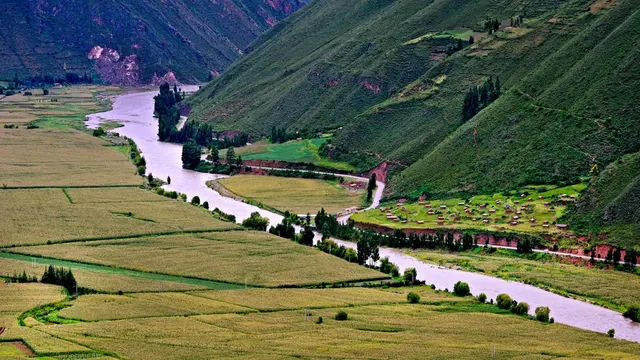
Lares is an Andean valley in Calca Province, north of the Sacred Valley, known for its hot springs and for its Quechua communities of herders and weavers. The Lares trek, or Lares trail, passes through those communities and over passes above 4,400 m in 3 to 4 days, then descends to Ollantaytambo and continues by train to Machu Picchu. It’s moderately difficult and has no permits with a quota, so you can book it at fairly short notice.
Here you’ll find where Lares is, what the route to Machu Picchu is like, the difficulty, the best time to go and what to bring. To compare Lares with the other routes, see our Machu Picchu treks compared guide.
Lares at a glance
| Fact | Lares trek |
|---|---|
| Location | Lares Valley, Calca Province, Cusco |
| Distance from Cusco | About 3 h by road to Lares |
| Duration | 3 to 4 days, with the last one devoted to Machu Picchu |
| Maximum elevation | Passes above 4,400 m, depending on the variant |
| Difficulty | Moderate; less demanding than the Salkantay |
| Permit | No daily quota |
| Accommodation | Campsites next to communities and lakes |
| End point | Ollantaytambo and the train to Aguas Calientes |
| Best season | April to October |
Where is Lares?
The Lares Valley is in Calca Province, on the other side of the mountains that close off the Sacred Valley to the north. From Cusco you get there by road in about three hours: first to Calca, between Pisac and Urubamba, and then north on a mountain road. The town of Lares is the starting or finishing point of almost every variant of the trek.
The area combines puna, the high Andean grassland with glacial lakes and herds of llamas and alpacas, with lower, warmer ravines. In between live Quechua communities that keep up loom weaving, traditional dress and a herding way of life.
The Lares trek to Machu Picchu
There isn’t a single Lares trek, but rather a network of trails between communities. Each operator combines different passes and villages, which is why the distance and maximum elevation change from one variant to another. What they share is the basic outline: two or three days hiking through the mountains, a descent to the Sacred Valley and a train to Aguas Calientes.
Sample 4-day itinerary
| Day | Route | Highlights |
|---|---|---|
| 1 | Cusco → Lares → first campsite | The Lares hot springs and arrival at a weaving community, such as Huacahuasi |
| 2 | Crossing the highest pass | Passes above 4,400 m, glacial lakes and snowcapped peaks |
| 3 | Descent toward the Patacancha Valley and Ollantaytambo | Weaving communities and the train to Aguas Calientes |
| 4 | Visit to Machu Picchu and return | A guided tour of the citadel |
In the 3-day version the hiking is shorter and you reach Ollantaytambo sooner. Some itineraries save the hot springs for the end, as a reward after the last pass.
The last stretch, by train
Unlike the Inca Trail, the Lares trek doesn’t reach Machu Picchu on foot. From Ollantaytambo you take the train to Aguas Calientes, sleep in town and go up to the citadel the next day. Train classes and schedules are in our guide to the train to Machu Picchu.
Important: the Lares trek doesn’t include entry to the citadel on its own. Check whether your operator buys the Machu Picchu ticket and the train, or buy them yourself well in advance, especially from June to August.
What makes Lares special
- It’s the most cultural trek: you walk among living communities, not ruins. You get to see how wool is spun, dyed and woven.
- There are fewer people: it gets far fewer hikers than the Inca Trail or the Salkantay.
- Puna scenery: lakes, snowcapped peaks and herds of llamas and alpacas.
- Hot springs: the Lares baths, at the start or the end.
Tip: if you buy textiles, buy them directly from the weavers in the communities you pass through. Ask before photographing people and respect it if they say no.
Lares on your own or with an agency
Since there’s no permit with a quota, the Lares trek can be done independently if you have experience hiking at altitude, carry a tent and food and know how to navigate. The trails link communities and aren’t always signposted, and there are few services between one village and the next.
On an organized trek, the gear goes on horses or mules, there’s a cook and a guide who knows the trails and usually speaks Quechua, which makes it easier to connect with local families. Compare what each option includes: transportation to Lares, entry to the hot springs, nights camping, the train from Ollantaytambo and the Machu Picchu ticket.
Lares trek difficulty
It’s a moderate trek. The days are shorter than on the Salkantay and there aren’t thousands of steps like on the Inca Trail. What makes it demanding is the altitude: the passes go above 4,400 m and you sleep at high, cold campsites.
- Acclimatization: spend at least two days in Cusco or the Sacred Valley before you start. Review the warning signs in altitude sickness in Cusco.
- Fitness: it’s enough to be used to walking for several hours with some climbs.
- Cold: nights in the puna drop below freezing in the dry season.
This information is general and doesn’t replace your doctor’s advice.
Best time for the Lares trek
From April to October, in the dry season, the trails are firm and the snowcapped peaks are clear. It’s also the season with the coldest nights. From November to March it rains often, and the passes can be muddy or hit by hail. Lares doesn’t close in February, so it’s an alternative when the Inca Trail is closed. Check Cusco weather by month.
What to bring
- A sleeping bag rated for below-freezing temperatures.
- Layers, a warm hat, gloves and a rain jacket.
- A swimsuit and a small towel for the hot springs.
- Broken-in boots and trekking poles.
- Sunscreen, sunglasses and cash in soles for small purchases.
You’ll find the full list in our Cusco packing list.
Summary: Lares, Salkantay or the Inca Trail?
- Lares: if you’re interested in living Andean culture and want fewer people and moderate difficulty.
- Salkantay: if you’re after high mountains, glaciers and the descent into the jungle.
- Inca Trail: if you want archaeological sites along the way and to walk into Machu Picchu on foot.
To see how Lares fits into a week, take a look at our Cusco itinerary.
Frequently asked questions
Where is the Lares trail in Peru?
In Calca Province, Cusco Region, north of the Sacred Valley. You get there by road from Cusco in about three hours.
How many days is the Lares trek to Machu Picchu?
Between 3 and 4 days, with the last one devoted to visiting Machu Picchu.
Is the Lares trek difficult?
It’s moderate: the days are shorter than on the Salkantay, but the passes go above 4,400 m, so you need to acclimatize first.
Do you need a permit for the Lares trek?
No. It has no daily quota like the Inca Trail, so you can book it at short notice. The Machu Picchu ticket is bought separately.
Does the Lares trek reach Machu Picchu on foot?
No. It ends in Ollantaytambo, where you take the train to Aguas Calientes; you visit the citadel the following day.
Which is better, Lares or Salkantay?
Lares is shorter, moderate and more cultural; the Salkantay is higher, longer and has more varied scenery. Choose Lares if the altitude of the Salkantay Pass worries you or you have one day less.
Official sources
- PeruRail: trains from Ollantaytambo to Machu Picchu perurail.com
- Tu Boleto (Peru’s Ministry of Culture): official Machu Picchu ticket sales tuboleto.cultura.pe

How we put this guide together
Written by Paul Pumalloclla · 17 years in tourism
- Official sources Prices, opening hours and rules checked against Peru’s Ministry of Culture, SERNANP, PromPerú and the train and bus operators.
- Sources cited Every guide links to the sources we used at the end.
- Always up to date When a rule changes, we update the guide and its date.
We’re not a travel agency: we don’t sell tours or take bookings. If a link belongs to a commercial partner, we label it next to the link, and that never changes the facts or the recommendations.
Guide history
- Published
- Last reviewed
Spotted something out of date?
Let us know and we’ll check it against the official source.
Report a change