Key facts
- Q'eswachaka is the last Inca grass-rope bridge still in use: about 28 to 30 m long, over the Apurímac River.
- It’s in the district of Quehue, province of Canas, about 180 km south of Cusco (about 3 h 30 min by road).
- It sits at an elevation of about 3,700 m.
- Every June the communities renew it over three days; UNESCO recognized it as Intangible Cultural Heritage in 2013.
- It’s visited on a full-day trip from Cusco, combined with the Four Lakes route.
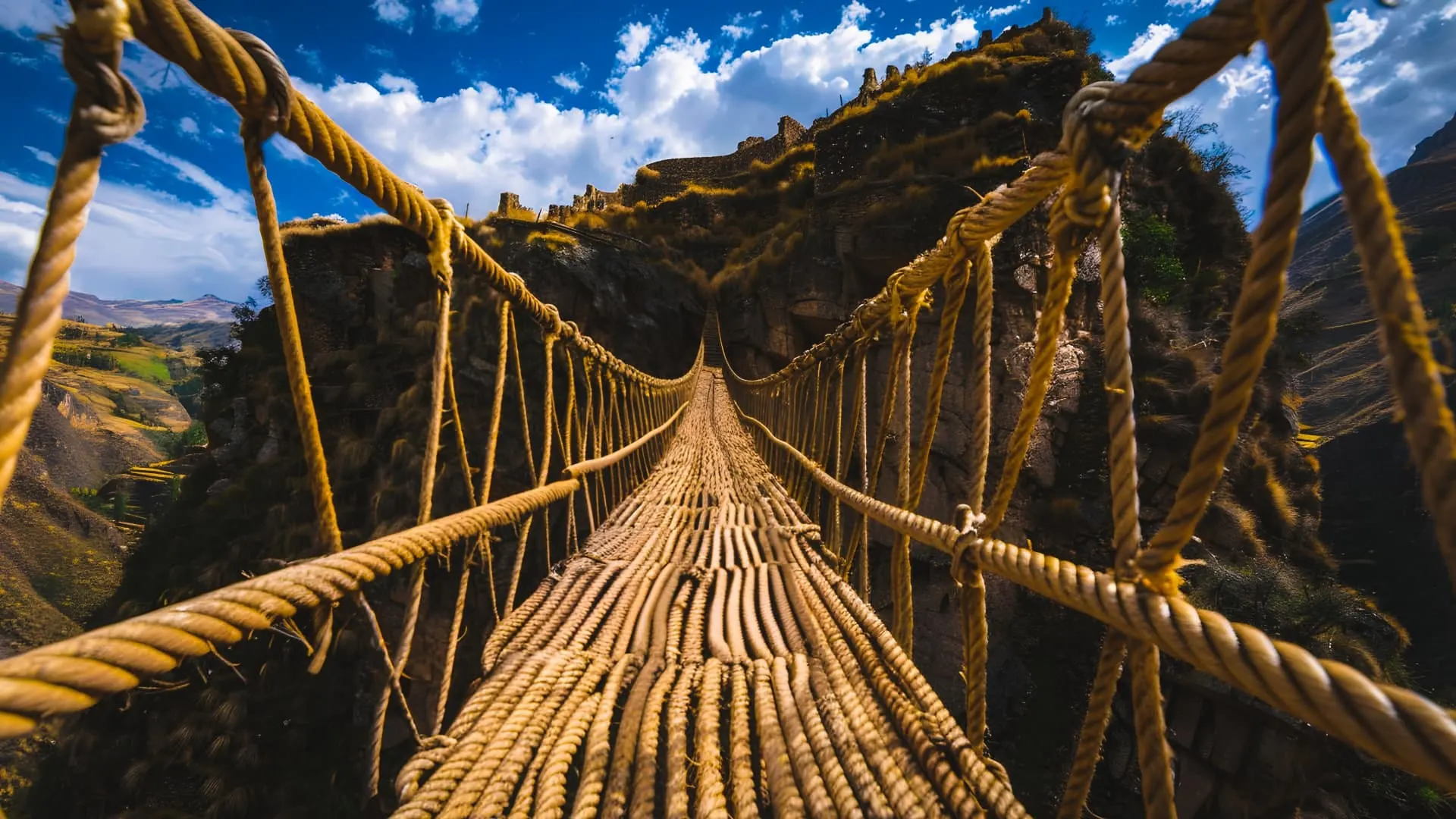
Q’eswachaka is the last Inca suspension bridge still in use: a bridge about 28 to 30 m long, made of braided grass ropes, that spans the Apurímac River in the district of Quehue, province of Canas, about 3 h 30 min from Cusco. Every year in June, the local communities take it down and weave it again over three days of collective work and rituals. That renewal has been recognized by UNESCO as Intangible Cultural Heritage of Humanity since 2013.
What is the Q’eswachaka bridge?
The Q’eswachaka bridge is a plant-fiber bridge that keeps alive the technique the Incas used to cross the canyons of the Andes. Its name is linked to q’eswa, the braided grass rope, and chaka, “bridge.” It’s about 28 m long according to PromPerú, or about 30 m according to other publications from the same agency, and around 1.20 m wide. It hangs over a gorge of the Apurímac at an elevation of about 3,700 m.
What makes it exceptional isn’t just the bridge itself, but the fact that it’s still alive. The Incas built many bridges like this one along their road network, the Qhapaq Ñan, to cross rivers and ravines. Almost all of them have disappeared. Q’eswachaka survives because the communities never stopped renewing it, using the same technique for more than six centuries.
The last Inca bridge: a UNESCO-listed tradition
In 2013, UNESCO added the knowledge, skills and rituals related to the annual renewal of the bridge to its Representative List of the Intangible Cultural Heritage of Humanity. What’s protected isn’t the object, which is rebuilt every year, but the know-how of the Quechua communities that maintain it: Huinchiri, Chaupibanda, Choccayhua and Ccollana Quehue, according to UNESCO; the Andina news agency also mentions Perccaro and Chiripampa.
In May 2025, community members found cuts near the bridge’s abutments. The authorities set up a technical working group with the Dirección Desconcentrada de Cultura de Cusco, the regional office of Peru’s Ministry of Culture, to protect it, and the bridge was renewed and reopened to visitors in June, as it is every year.
Where is the Q’eswachaka bridge?
The bridge is in the district of Quehue, province of Canas, in the southern part of the Cusco region. PromPerú places it about 180 km south of the city, a trip of about 3 h 30 min by road. The route leaves along the road to Puno, passes through Combapata and climbs to Yanaoca, the capital of Canas; from there it’s roughly an hour to the bridge.
How the Inca suspension bridge is renewed every year
The renewal is a communal work effort in the style of the Inca minka. According to UNESCO, it lasts three days and follows roughly these steps:
- Before starting, a ceremony of offerings is made to Pachamama and the apus, the sacred mountains.
- Families cut grass from the highlands, q’oya ichu, and braid it into thin cords.
- Those cords are twisted into six thick ropes about 70 m long, under the direction of two master builders.
- The men stretch the ropes across the river and tie them to the ancient stone bases on each bank.
- Two master weavers work their way from each end toward the middle, weaving the handrails and the floor.
- On the last day, the bridge is inaugurated with music, dances and the villagers crossing it.
The previous year’s bridge is taken down before the new one is strung up. Besides the grass, the work also uses stems of native plants and cowhide.
When is the Q’eswachaka renewal?
The renewal takes place in June, usually during the second week of the month, according to PromPerú. The communities set the exact dates each year, so confirm them with the Quehue municipal office or local sources as June approaches. It’s the best time to see it, with a folk festival and dance competitions, but also the busiest.
The rest of the year you can visit the bridge and, if it’s in good condition, cross it. As the months go by, the grass dries out and wears down, so ask on site whether crossing is allowed that day.
Important: the bridge is on community land. Follow the community members’ instructions: cross a few people at a time, without running or making it sway, and don’t take any grass as a souvenir.
How to get to Q’eswachaka from Cusco
Q’eswachaka is visited on a full-day trip from Cusco. There are two usual ways:
- Organized day trip: the most comfortable option, according to PromPerú. It usually leaves before dawn and combines the bridge with the Four Lakes route.
- On your own: a bus from Cusco to Combapata, along the road to Puno; from there, local transportation to Yanaoca, and from Yanaoca, a private vehicle for about 60 minutes to the bridge. It means leaving very early and negotiating the last stretch.
If you want to stay overnight in the area to see the renewal, keep in mind that services are very basic and that in June nighttime temperatures drop below 0 °C. Details on the cold by season are in our guide to Cusco weather.
The Four Lakes and other places nearby
The road to Q’eswachaka runs along the Four Lakes route: Pomacanchi, Acopía, Asnaqocha and Pampamarca, in the provinces of Acomayo and Canas, at an elevation of about 3,500 m. They’re high Andean lakes surrounded by villages and farmland, and stopping at their viewpoints is part of the day.
The same part of southern Cusco has other little-visited sites. The Waqrapukara sanctuary, in Acomayo, is a separate high-mountain trip. And if you’re taking the road to Puno, the Temple of Wiracocha at Raqchi and the church of Andahuaylillas are on the way.
Q’eswachaka vs. the Inca Bridge at Machu Picchu
Many travelers search for the “Inca bridge” and come across two different places. This table sums up the differences:
| Detail | Q’eswachaka bridge | Inca Bridge at Machu Picchu |
|---|---|---|
| What it is | A suspension bridge of grass ropes over the Apurímac River | A passage of stone and logs on the face of a cliff |
| Where | Quehue, province of Canas, about 3 h 30 min from Cusco | Inside the Machu Picchu Sanctuary |
| Can you cross it? | Yes, when it’s in good condition and the communities allow it | No: you view it from a lookout |
| How to visit | Full-day trip from Cusco | With a ticket for Route 1-D of the Panoramic circuit |
| What makes it special | It’s rebuilt every June using Inca techniques | It was a secondary, defensive access route to the Inca city |
If you’re interested in the one at Machu Picchu, you’ll find all the details in our guide to the Inca Bridge at Machu Picchu.
Tips for visiting Q’eswachaka
- Dress in layers and bring a hat and sunscreen: at 3,700 m the sun burns and the wind chills.
- Cash in soles for any community fee and purchases along the way; don’t count on paying by card.
- Shoes with good soles: the path from the road down to the bridge can be steep.
- If you suffer from vertigo, view the bridge from the bank; you don’t have to cross it.
- Don’t do it on the day you arrive in Cusco: it’s many hours of travel at high altitude. Read our guide to altitude sickness in Cusco.
Tip: if you’re traveling in June and want to see the renewal, plan the rest of your trip around those dates. It coincides with Inti Raymi and high season, so book your lodging and your trains to Machu Picchu early.
Summary: is Q’eswachaka worth visiting?
It’s worth it if you’re more interested in the living traditions of the Andes than in archaeological sites, and even more so if you can go during the June renewal. It’s a long day on the road, so it makes sense on trips of five days or more. Fit it in with our 3-, 5- and 7-day Cusco itineraries, work out the costs with our Cusco trip budget and discover other plans in things to do in Cusco.
Frequently asked questions
Where is the Q'eswachaka bridge?
In the district of Quehue, province of Canas, in the southern part of the Cusco region. You get there along the road to Puno as far as Combapata and then via Yanaoca.
When is the Q'eswachaka bridge renewal?
In June, usually during the second week of the month. The communities set the exact dates each year, so confirm them as June approaches.
How long is the Q'eswachaka bridge?
About 28 to 30 m long and around 1.20 m wide, according to PromPerú. It hangs over a gorge of the Apurímac River.
What is the Q'eswachaka bridge made of?
Ropes of highland grass (q'oya ichu) braided by hand, with stems of native plants and leather in some parts. It’s tied to Inca stone bases on each bank.
Can you cross the Q'eswachaka bridge?
Yes, when it’s in good condition and the communities allow it. Cross slowly, a few people at a time and without making it sway; if you have vertigo, you can view it from the bank.
How long does it take to get from Cusco to Q'eswachaka?
About 3 h 30 min by road, according to PromPerú. It’s a full-day trip, round trip.
Why is Q'eswachaka a UNESCO World Heritage tradition?
Because in 2013 UNESCO listed the knowledge, skills and rituals of its annual renewal as Intangible Cultural Heritage. What’s protected is the communal know-how that keeps the Inca technique alive, not just the bridge.
Is Q'eswachaka the same as the Inca Bridge at Machu Picchu?
No. Q'eswachaka is a grass suspension bridge in the province of Canas; the Inca Bridge at Machu Picchu is a stone-and-log passage inside the sanctuary, viewed from a lookout.
Official sources

How we put this guide together
Written by Paul Pumalloclla · 17 years in tourism
- Official sources Prices, opening hours and rules checked against Peru’s Ministry of Culture, SERNANP, PromPerú and the train and bus operators.
- Sources cited Every guide links to the sources we used at the end.
- Always up to date When a rule changes, we update the guide and its date.
We’re not a travel agency: we don’t sell tours or take bookings. If a link belongs to a commercial partner, we label it next to the link, and that never changes the facts or the recommendations.
Guide history
- Published
- Last reviewed
Spotted something out of date?
Let us know and we’ll check it against the official source.
Report a change